by Derf Johnson & Katy Spence
Montanans continue to push back against efforts by international commodities trading firm Glencore to get a free license to pollute Montana’s waters. Glencore owns and operates massive metallurgical coal strip mines in British Columbia’s (B.C.) Elk Valley, which cause pollution runoff into adjacent waterways, including dangerous levels of selenium. Ultimately, this pollution enters the Elk River, which flows into Montana and forms Lake Koocanusa.
Last summer, we were successful in helping to stop an attempt by the Lincoln County Commissioners to legalize Glencore’s pollution of Montana’s waters through a rulemaking petition to the Montana Department of Environmental Quality (DEQ). DEQ rejected that petition. Our ongoing litigation to defend Montana’s water quality selenium standard from Glencore’s attempt to weaken it is now fully briefed and argued, and we are awaiting a decision in that case.
But the world keeps turning, and we are going to have to continue this fight on even more fronts. The province of B.C. is now processing an application that would allow for a major expansion of the open pit coal mine at Fording River, and recently MEIC had to bring suit against Lincoln County for its failure to respond to an information request on their rule-making petition.
Fording River Extension
As if the watershed hadn’t suffered enough under the toxic discharge from four active (and one inactive, but still problematic) coal mines, B.C. is also considering a large expansion to the Fording River Mine.
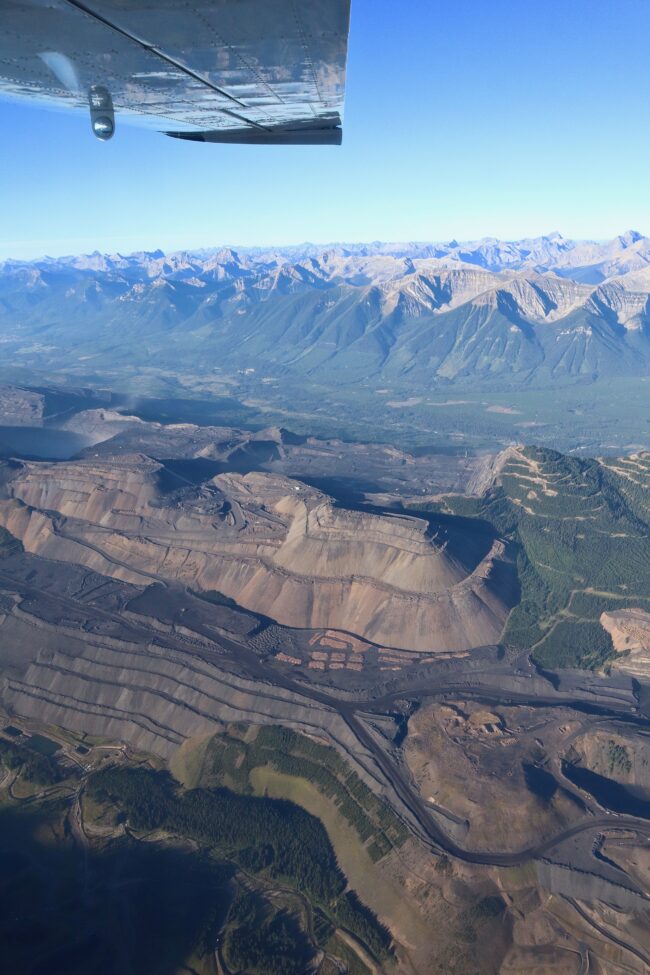
The Fording River Mine is a mountaintop removal coal mine in B.C.’s Elk Valley. Photo by Alec Underwood
The Fording River Extension would expand the province’s biggest coal mine by nearly 5,000 acres. The mountain would be decapitated to remove the coal, and the three billion cubic meters of waste rock would be dumped into an adjacent river valley.
The Environmental Assessment for this project is riddled with inadequacies. Not only does it fail to adequately address the existing selenium pollution from these mines, but it fails to provide adequate bonding or mitigation for the enormous amount of pollution this expansion will undoubtedly produce. On top of that, this expansion will be a climate disaster; B.C. advocacy group Wildsight estimates that unreported scope 3 emissions of Elk Valley mines (i.e. emissions from burning the coal mined in the Elk Valley) have exceeded all of B.C.’s reported greenhouse gas emissions in recent years. What’s more, these coal mines are a disaster for water quality in British Columbia, Montana, and Idaho, and pollution is being recorded even as far downriver as Washington and back into B.C.
It is especially egregious that B.C. and Canada are even considering the permitting of an enormous coal mine expansion in this watershed, as the province is also part of an international joint effort to address and mitigate the existing pollution under the International Joint Commission (IJC) process. This years-long process brings together commissioners from the U.S. and Canada to oversee groups that compile data, study impacts, gather public input, and make recommendations on how to address transboundary water pollution.
It took years for this particular watershed to get an IJC reference, and efforts were spearheaded by the Ktunaxa Nation. For the B.C. provincial government to claim to care about transboundary waters in one setting while considering an enormous, polluting expansion in another setting is self-sabotage at the expense of everyone and the ecosystems involved.
MEIC Sues Lincoln County for Failure to Respond to Records Request
Last summer, Lincoln County Commissioners submitted a rulemaking petition to the Montana Department of Environmental Quality that would have weakened Montana’s site-specific selenium standards. Thankfully, the DEQ rejected the petition after overwhelming opposition from across Montana.
However, something smelled funny. Why would Lincoln County Commissioners submit a petition to weaken water quality standards in order to benefit a coal mining operation that does not benefit Lincoln County? MEIC submitted a records request just a few days after the petition was filed, asking for all of the documents and communications that led to the petition. It’s a reasonable assumption that Lincoln County was just doing the dirty work, and Glencore (the international commodities trading firm that owns the coal mines) was the real entity behind the petition.
Instead of complying with Montana’s constitutionally protected Right to Know, Lincoln County ignored the petition. In January of this year, MEIC took Lincoln County to court. Hopefully, we will be able to get the public documents and discern exactly why the Lincoln County Commissioners want to increase water pollution for their constituents.
This article was published in the March 2026 issue of Down To Earth.