by Nick Fitzmaurice
In July 2024, NorthWestern Energy filed an application with the Montana Public Service Commission (PSC) to increase residential electricity base rates by 26%. This came on the heels of a decision by the PSC in October 2023 to approve a 28% increase to NorthWestern’s residential electric customers. As of this writing, the PSC has voted to delay issuing their final order on NorthWestern’s current rate case following their public hearing and final briefs from NorthWestern and intervening parties such as MEIC. A final decision is expected by mid-December.
At a high level, electricity rates are comprised of fixed base rates, set in rate cases before the PSC to pay for large infrastructure investments such as power plants, and variable rates, adjusted more regularly to account for utilities’ variable costs. Utility rates can fluctuate based on variable factors, including the utility’s property tax rates, the costs and amounts of fuel consumed (i.e., coal and gas), sales and purchases of electricity from other utilities, and other factors. NorthWestern implemented an interim rate increase this summer as part of the current rate case (subject to refund should it exceed the PSC’s final order), at which point the average residential customer bill was 39.4% higher than in August 2022 based on NorthWestern’s own numbers.
MEIC’s intervention primarily focused on the following issues: whether customers should be charged for the Yellowstone County Generating Station (YCGS) methane gas plant, and, if so, how much; the future costs and potential retirement planning for the expensive and unreliable Colstrip power plant; whether NorthWestern and the PSC should consider climate change risks in making and approving infrastructure investments; and the affordability of NorthWestern’s proposed rate increases. If the PSC approves NorthWestern’s request for YCGS, the average residential electricity customer would be paying an additional $10.52 per month ($126.24 per year) for this expensive and polluting gas plant. In November, the PSC’s staff filed its recommendations for the Commission’s final order, which included an acknowledgement of numerous issues associated with the selection and construction of YCGS and the associated costs of that plant. (See MEIC’s website and previous Down to Earth publications for more details about NorthWestern Energy’s rate case.)
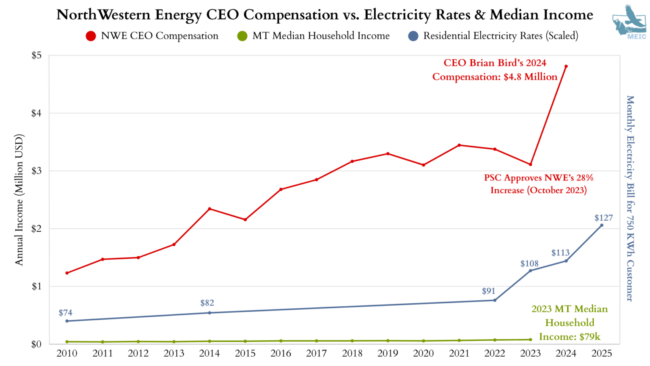
Compensation for NorthWestern’s CEO has increased dramatically in recent years, from $1.2 million in 2010 to an outrageous $4.8 million in 2024. Over that same period, Montana’s median household income has increased only modestly, just barely keeping up with inflation. Overlaid on this chart are residential electricity bill snapshots over the years, representing what a 750-kilowatt-hour (KWh) household would have paid for electricity in a given month. To represent these electricity data points on the same Million USD scale as the data for CEO compensation and median household income, monthly rates are cubed. For example, cubing the monthly bill of $73.75 in 2010 scales the value to $0.401 billion. Cubing the monthly bill of $127.24 in 2025 scales the value to $2.060 billion.
While providing reliable electricity to Montanans is not free, it is apparent that compensating its executives and shareholders is more important to Montana’s largest monopoly utility than providing affordable energy to its customers. As electricity prices have skyrocketed over the last few years, so have NorthWestern executives’ compensation. CEO Brian Bird has seen the largest compensation increase, up 55% from $3.1 million in 2023 to $4.8 million in 2024. NorthWestern’s rate increases are not the result of investments in reliable electricity. They are the result of a greedy monopoly utility taking as much as it can from cash-strapped Montanans and giving it to a CEO based in South Dakota. If the PSC approves another rate hike this fall, you can bet that NorthWestern’s executives will see another handsome bonus.
Suffice it to say, Montanans cannot afford this steady stream of crippling electricity rate hikes, and the CEO of the utility responsible for those hikes certainly doesn’t deserve to be rewarded for making Montanans’ electric bills unaffordable.
This article was published in the December 2025 issue of Down To Earth.