

Study: Montana Regional Transmission Connectivity
Transmission infrastructure in the Northwest has not been significantly updated in half a century.
As the region continues to grow, the existing interregional system is approaching its limits. Northwest electric utilities, grid operators and other industry leaders and policymakers have recognized the critical need to expand transmission capacity across the region to ensure abundant, reliable and affordable energy.
The Western Transmission Expansion Coalition (WestTEC) – the broadest cross section of electric utilities, transmission planners and developers, state and federal agencies, Tribal representatives and public interest organizations – recently released a 10-year plan that identifies essential new transmission corridors across the West, including in the Northwest.
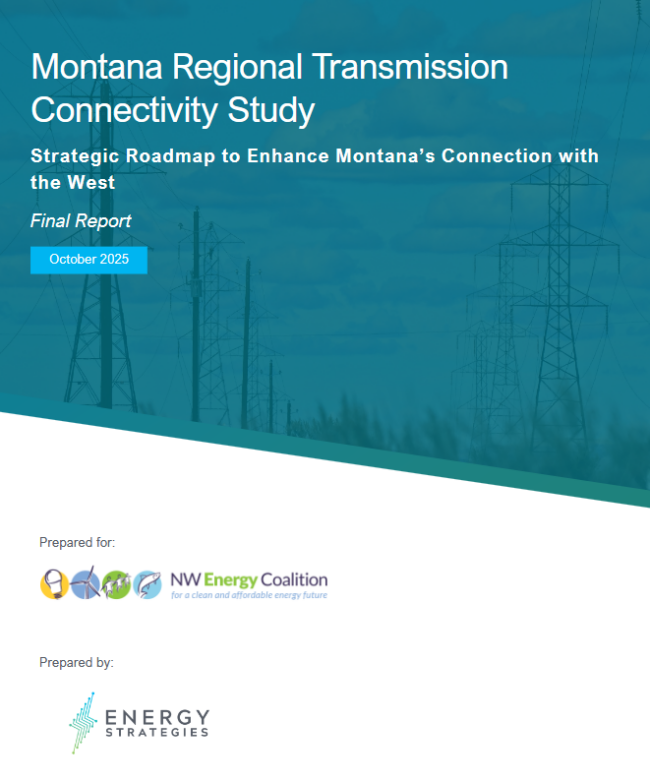
To further encourage an informed discussion about transmission options in the Northwest, the NW Energy Coalition (NWEC) and partner organizations including MEIC commissioned Energy Strategies and Montara Mountain Energy to analyze potential pathways for delivering as much as 12,000 MW of new energy from Montana to the grid by 2035, while minimizing impacts on people and landscapes. This study and the WestTEC study have the same primary recommendations for new transmission corridors.
Montana, Idaho, Oregon and Washington have a long history of trading power but the existing transmission system will not be able to meet future needs.
The study provides an important independent analysis that will inform robust conversations among Tribes, counties, states, federal entities, communities and stakeholders about a wide range of future transmission options including key upgrades of existing lines and new lines that would create a more efficient and reliable grid that provides access to the lowest-cost resources.
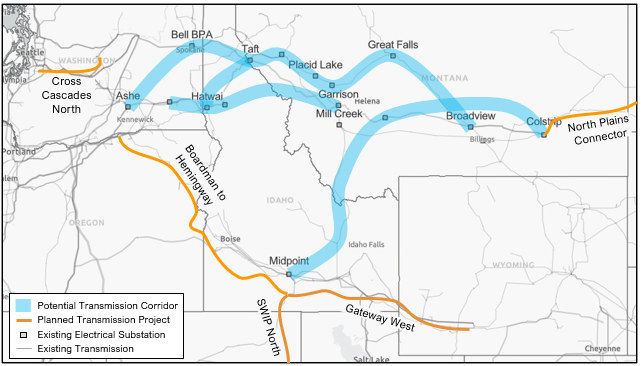
It is important to note that this is not an engineering study with pre-determined transmission locations. The maps in the study are representations of possible corridors with wide latitude for discussing priorities for development of any transmission expansion as well as any actual line placement. Specific project and sitting recommendations should only occur after extensive dialogue with landowners, local communities, Tribes, governments, and other interested parties.
MEIC, NWEC, and partners will use the study to engage communities and affected groups about potential transmission routes before detailed engineering and routing studies are created. Our groups recognize that transmission planning in the past has not always followed a “community-first” approach. The lack of early engagement has led to protracted permitting processes and lawsuits which can delay transmission projects by an additional five to ten years.
MEIC is part of an effort led by NWEC to advocate for a new approach to transmission planning — one that seeks to engage with stakeholders and communities early in the planning process, to identify needs, concerns, opportunities and benefits right from the start. In addition to the direct energy benefits of increased transmission connectivity and capacity, there are local benefits for communities, including electric reliability, reduced energy costs, access to wholesale markets, job creation, tax revenue and economic development.
Montana, Idaho, Oregon and Washington have a long history of trading power but the existing transmission system will not be able to meet future needs. This study is a tool to begin important and necessary conversations to achieve the goal of a safe, reliable and efficient electricity grid that can provide access to the lowest cost energy resources.
Below is a map that provides a conceptual representation of potential corridors. The maps in the study were used as examples only to help with cost estimates.
Frequently Asked Questions (FAQ)
Click the arrows to explore frequently asked questions.
The intent was to create a starting point for discussions about the need for and location of additional transmission. The study contains practical recommendations and data designed to support the development and construction of regional transmission that improves the reliability and efficiency of the Northwest’s power grid. The study provides a credible evidence-based foundation that Tribes, communities, developers, utilities, regulators and others can use to discuss and provide input on potential regional transmission.
The Energy Strategies consulting group conducted the study. The study was funded by a coalition intent on reducing community and environmental impact of new transmission through increased community engagement. The coalition includes: NW Energy Coalition, The Nature Conservancy, The Natural Resources Defense Council, Earthjustice, Sierra Club, The Audubon Society, Montana Environmental Information Center, Conservation Northwest, GridLab, Idaho Conservation League, Climate Solutions, The Energy Foundation, and the Washington State Department of Commerce.
The coalition is using the study as a starting point for discussions on the need for and location of additional transmission. They are gathering feedback from Tribes, communities and other interested organizations. This feedback will be provided to potential transmission developers, utilities and regulators to ensure community input is included in the design and location of the transmission lines.
This study provides transmission recommendations for the future grid that supports increased reliability by ensuring resource adequacy and increasing resiliency. Benefits of completing the recommended transmission solutions include:
- Improving efficiency of grid operations, reducing congestion and lowering operating costs
- Enhancing the ability to operate as an integrated network, sharing resources from one region to another especially in stressed conditions
- Enabling the grid to support continued load growth and economic development across the region
- Creating a transmission system that can deliver the lowest-cost energy resources where and when they are needed to improve energy affordability
Without this transmission infrastructure, it will be difficult to add new regional generation resources and it will increase the risk of not being able to reliably deliver electricity across the region. Extreme weather events are increasingly stressing the grid which is already at near capacity limits. There could also be higher costs due to increased electricity purchases from outside the region and decreased reliability. In addition, states could struggle to meet policy objectives.
No. The lines shown on the maps are illustrations of conceptual potential transmission corridors and do not represent actual siting, alignments or final corridors for these projects. The maps in the study are representations of possible corridors with wide latitude for discussing priorities for development of any transmission expansion as well as any actual line placement. Specific project and siting recommendations should only occur after extensive engagement with landowners, local communities, Tribes, governments, and other interested parties.
With community-driven decision-making, Tribes, landowners, communities and local, state and federal agencies will need to make the final decisions. One of the purposes of this study is to gather input to design final routes endorsed by the affected communities. There is always a tradeoff between bringing affordable and reliable power to communities and the impacts of the power lines. Engagement with communities and stakeholders is critical.
Montana Environmental
Information Center
Clean and healthful.
It's your right, our mission.
Stay Connected
P: (406) 443-2520
E: meic@meic.org
324 Fuller Ave, #C-8
Helena, MT 59601
Mailing addresses:
P.O. Box 1184, Helena, MT, 59624
225 W. Front, Missoula, MT, 59802