Protecting Air & Water
Fossil fuel development and the toxic burning of hazardous waste are just a few factors contributing to the degradation of Montana’s air quality and climate. With the ultimate goal of air that is clean and safe to breathe and a stable climate, MEIC works with citizen groups, supports legislation, and acts as an agency watchdog to ensure that legal safeguards are complied with and enforced.
Clean Water
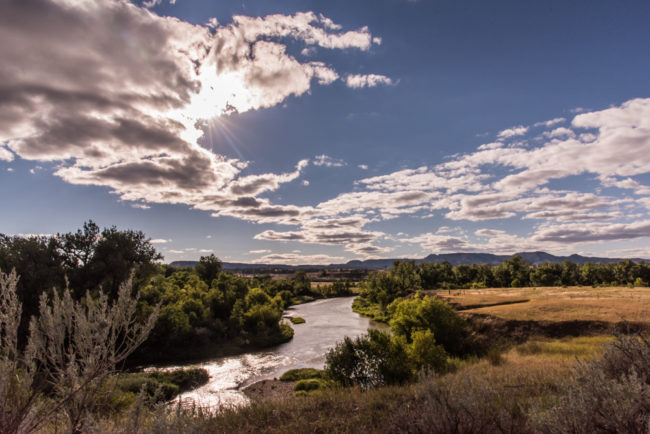
Threats to our clean and cold water can impact the health of people, livestock, wildlife, and landscapes. From increasing numbers of poorly-regulated opencut mines (gravel pits) to nutrient pollution to hardrock mining, MEIC monitors and advocates for policy that will protect our water quality.
Hardrock Mining
The impacts of irresponsible hardrock and cyanide mining in Montana will affect our great state for decades to come. Abandoned and inactive mines litter the state, leaving behind scarred landscapes and contaminated water. MEIC is a respected leader in mining reform and the architect of Montana’s cyanide heap leach mining ban.
MEIC has been at the forefront of hardrock mining reform in Montana, working with government agencies, the legislature, and people across the state to assure that our water stays clean and mining disturbance is fully bonded and reclaimed.
MEIC fights for clean water by protecting Montana from cyanide-leach gold mining and other destructive mining practices, including the need to to prioritize cleanup of abandoned and inactive mines, prohibit mining in sensitive ecosystems and high-risk ore bodies, and fully reclaiming all mines.
MEIC is defending Montana from irresponsible mining proposals by:
Protecting Our Blackfoot River
The Blackfoot River is part of western Montana’s cultural identity and has also become a cornerstone of its economy. Not only is this the famous “river that runs through it,” a recent University of Montana study found that Montana’s 2024-2025 fishing season generated $919 million in direct activity, with a total economic impact of $1.5 billion and nearly 16,000 jobs supported. On any summer day, the Blackfoot’s access sites are full of anglers, floaters, and families — people drawn by the unmatched recreation this river provides. But that recreation economy only exists as long as we protect the river itself.
Australian corporation Sentinel Metals’ has proposed the Columbia Gold Project, situated in the vital headwaters of the Blackfoot just east of Lincoln. The company is after gold, a highly valuable precious metal used primarily for gold bars and jewelery — nothing that justifies destroying a quintessential Montana river.
The Blackfoot is more precious than gold, and MEIC has decades of experience protecting this river from gold mines. Learn more about what MEIC and our partners are doing to protect this river.
Protecting the Cabinet Mountains
Two long-proposed mines threaten the Cabinet Mountains Wilderness, one of the original wilderness areas created by the passage of the 1964 Wilderness Act. The projects are owned by Hecla Mining of Idaho.
MEIC has been involved in the effort since the 1980s to prevent these mines from being built. Montanore threatens the water quality of Libby Creek and the Kootenai River, the small grizzly bear population in the Cabinet/Yaak ecosystem, and Canadian lynx habitat.
The Montanore Mine is an underground copper and silver project proposed under the Cabinet Mountains Wilderness from the east side of the range. The better known Rock Creek Project is proposed on the west side. It would have the same impacts, albeit to the Bull and the Clark Fork Rivers.
Protecting Ground- and Surface Water
While mining operations present a number of pollution challenges for Montana’s waters, other human-caused pollution can present a challenge for our waterways.
MEIC is pushing for state action to address widespread nutrient pollution. This pollution, in the form of excess nitrogen and phosphorus, enters waterways from fertilizers, animal manure, sewage treatment facilities, and other sources. It can cause algal growth (algal blooms) that negatively impacts stream health and aquatic life, and has serious impacts to human health at high levels, especially infants and other vulnerable populations. The Montana Legislature repealed numeric nutrient standards in 2021 but has yet to adopt a replacement framework for addressing nutrient pollution. MEIC is working closely with our conservation partners and monitoring proposed regulations to assure that they protect Montana’s water.
For years, MEIC has been trying to address a loophole in the exempt well law that serves subdivision developers over preserving water resources for all use. Exempt wells were originally intended to protect the rural way of life by allowing farmers and ranchers to drill directly into groundwater for remote wells. By skirting permitting processes, unmitigated development is draining groundwater and basins and threatening rural communities.
Finally, groundwater and surface water test samples across Montana have identified unsafe levels of PFAS (per- and polyfluoroalkyl substances or “forever chemicals”), including widespread PFAS contamination in popular fisheries like the Fort Peck Reservoir, the East Gallatin, the Yellowstone River, and many more. Because of their virtually unbreakable carbon-fluorine bonds, PFAS persist indefinitely in the environment and exposure can lead to increased risk of certain cancers (such as kidney or testicular cancer), liver and kidney damage, immune system suppression, developmental effects in infants and complications during pregnancy.
Ban on Cyanide Mining in Montana with Initiative 137
On Nov. 6, 1998, Montanans voted 53% to 47% to support a citizen’s initiative, proposed by MEIC, to phase out open pit, cyanide-leach mining in Montana.
Despite numerous efforts by the legislature and by Canyon Resources to amend or repeal the initiative, it emerged unscathed. The initiative, now Montana state law, prohibits the development of new open pit cyanide leach mines, such as the McDonald Gold Project along the Blackfoot River.
The ban on cyanide mining in Montana with Initiative 137 was a response to the abysmal track record of open pit cyanide leach mining in Montana and the Montana Department of Environmental Quality’s failure to adequately regulate such mines as required by state law.
This is the statute language for the ban on cyanide heap-leach mining:
MCA 82-4-390. Cyanide heap and vat leach open-pit gold and silver mining prohibited. (1) Open -pit mining for gold or silver using heap leaching or vat leaching with cyanide ore-processing reagents is prohibited except as described in subsection (2).
(2) A mine described in this section operating on November 3, 1998, may continue operating under its existing operating permit or any amended permit that is necessary for the continued operation of the mine.
Clean and healthful. It's your right, our mission.
Clean Air
Fossil fuel development, forest fires, wood smoke, and the burning of toxic or hazardous substances are just some of the factors contributing to the degradation of Montana’s air quality and climate. With the ultimate goal of air that is clean and safe to breathe and a stable climate, MEIC works with local communities, legislators, and government agencies to ensure that the most vulnerable people are protected from harmful air pollution.
The quality of the air in Montana depends on many things including laws that limit air pollution, the enforcement of those laws, and public knowledge of whether the air is healthy on any given day. MEIC works to protect existing air quality laws, improve public access to health-based information, and guarantee that our laws are enforced, even when that means going to court to enforce clean air protections.
Air Pollution from Power Plants and Other Industrial Pollution Sources
Power plants are the largest individual sources of air pollution, including climate changing pollution, in Montana and across the United States. Currently there are no uniform national limits on the amount of climate changing pollution that power plants are allowed to emit. The Colstrip coal-fired power plant is one of the largest sources of air pollution carbon dioxide and air toxics like lead, arsenic, and cadmium in the nation.
When coal and gas are burned, harmful air pollutants like sulfur dioxide, nitrogen oxides, and particulates are released into the air. These pollutants cause and aggravate respiratory diseases, damage lung tissue, lead to premature death, harm vegetation, crops, and water quality. MEIC works to limit emissions from Montana’s fossil fuel power plants.
Montana Constitution
Often referred to as Montana’s “environmental watchdog,” MEIC successfully changes public policy and defends Montana’s Constitution. We increase the public’s understanding of and involvement in environmental problems and issues. Montana’s Constitution and the Montana Environmental Policy Act (MEPA) are very significant for protecting Montana’s environment. MEIC works to defend both as well as other important environmental laws.
Montana’s landmark Constitution, ratified in 1972, provides MEIC with our overall mission – maintaining a clean and healthful environment for all Montanans. The right to a clean and healthful environment has been recognized as a fundamental right – in a case that MEIC successfully brought to the Montana Supreme Court, MEIC v. DEQ, to prevent a large open-pit cyanide gold mine on the banks of the iconic Blackfoot River. We work to assure that the Montana Constitution is adequately and properly enforced to protect that right.
Montana Environmental
Information Center
Clean and healthful.
It's your right, our mission.
Stay Connected
P: (406) 443-2520
E: meic@meic.org
324 Fuller Ave, #C-8
Helena, MT 59601
Mailing addresses:
P.O. Box 1184, Helena, MT, 59624
225 W. Front, Missoula, MT, 59802