The Blackfoot River is part of western Montana’s cultural identity and has also become a cornerstone of its economy. A recent University of Montana study found that Montana’s 2024-2025 fishing season generated $919 million in direct activity, with a total economic impact of $1.5 billion and nearly 16,000 jobs supported. On any summer day, the Blackfoot’s access sites are full of anglers, floaters, and families — people drawn by the unmatched recreation this river provides. But that recreation economy only exists as long as we protect the river itself. The Blackfoot is more precious than gold, and MEIC has decades of experience protecting this river from gold mines.
The Proposed Mining Project
In early 2026, the Montana Department of Environmental Quality (DEQ) unveiled a draft Environmental Assessment (EA) for exploratory drilling for Sentinel Metals’ Columbia Gold Project, situated in the vital headwaters of the Blackfoot just east of Lincoln. Sentinel Metals is owned and operated by an Australian corporation, with Australian executives and investors. Any benefits from the mine are unlikely to stay in state — but the risks and the consequences absolutely will. Despite a short public comment window, MEIC and partners submitted robust technical comments opposing the deficient EA for the Columbia Gold Project, and more than 370 people submitted public comments opposing the project through MEIC’s website alone. The technical comments submitted by MEIC and our partners demonstrate that the EA is both legally and scientifically inadequate, necessitating a comprehensive Environmental Impact Statement (EIS). At the heart of the controversy is the improper downplaying of the project’s magnitude. By framing it as a minor exploration amendment, DEQ ignores the reality of a budding full-scale gold mine. Sentinel Metals’ own communications to investors boast of the deposit’s economic viability, yet the EA overlooks three decades of intensive activity involving more than 400 drill locations and 45,000 meters of drilling.
Furthermore, the assessment fails to grapple with the cumulative degradation of water quality, wildlife corridors, and critical fisheries. Although the Blackfoot’s headwaters are already burdened by heavy metals and sediment, the EA lacks essential baseline data. It conveniently ignores the looming threat of acid mine drainage and fails to evaluate how further drilling might exacerbate existing contamination in these sensitive waters. The mine proposal endangers the ecologically and culturally vital headwaters of the Blackfoot River — a landscape already scarred by the toxic legacy of industrial mining. The project also downplays or completely overlooks impacts on vulnerable species such as bull trout, grizzly bears, and Canada lynx, which remain inadequately protected. Beyond ecological concerns, the assessment neglects Tribal and cultural heritage while offering vague reclamation strategies and insufficient bonding details, failing to ensure the land is ever made whole again. Moreover, the DEQ has yet again undermined public transparency. While DEQ calls the project “an amendment” of an existing permit, DEQ has withheld the primary exploration permit and essential records during the comment period despite repeated requests. Given the significant potential for environmental, economic, and cultural harm within the Blackfoot Valley, state law and historical precedent demand nothing less than a rigorous EIS to protect this storied river.
The History
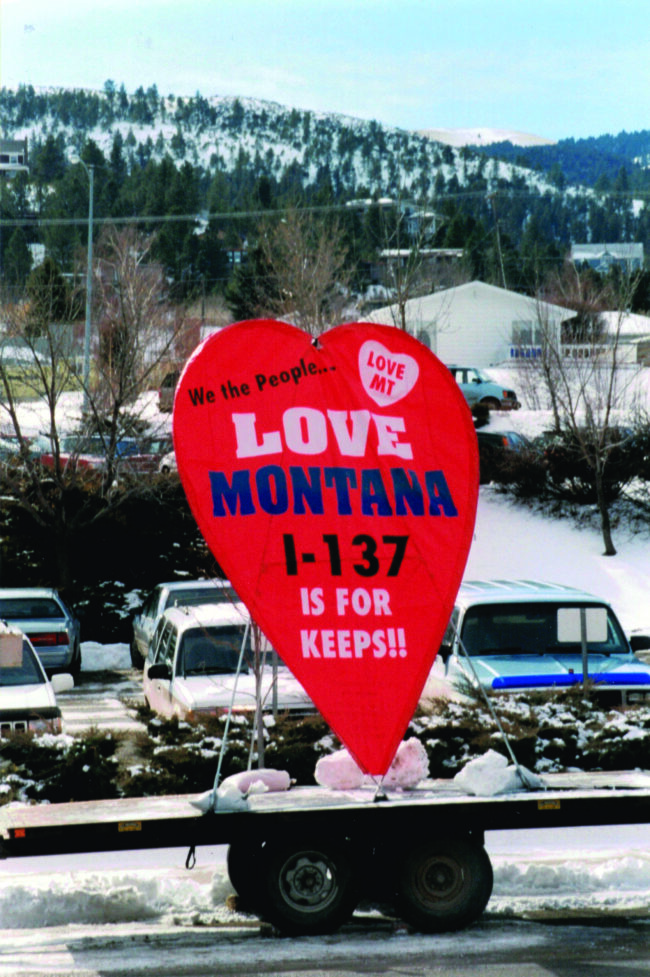
From the MEIC archives.
A River Runs Through It brought the Big Blackfoot River and its world-class coldwater fishery to the big screen in 1992, cementing its fame. However, the film wasn’t actually shot on the Blackfoot River, because the river was heavily polluted from industrial mining, logging, and erosion from more than a century of abuse. The river was still recovering from the Mike Horse mine disaster of 1975 in which the mine’s tailings dam blew out, dumping deadly levels of lead, copper and zinc into the Blackfoot. Mining threats to the Blackfoot reared their ugly heads throughout the 1990s. Finally, MEIC and Montana voters who were fed up with mining companies exploiting natural resources for private profit and leaving environmental disasters in their wake passed ballot initiative I-137 to ban open-pit cyanide heap leach mining. In 1999, after DEQ allowed the Seven-Up Pete Joint Venture to discharge arsenic and zinc contaminated groundwater near the Blackfoot River without conducting a nondegradation review, MEIC and partners went to court. MEIC won, and the case became one of Montana’s most important environmental rulings, establishing a strong precedent requiring rigorous environmental review for mining and other projects affecting public resources, and affirming that Montana’s constitutional rights to environmental protections are preventative and anticipatory. In 2004, mining interests attempted to repeal the cyanide heap leach ban through initiative, but Montanans rejected their efforts resoundingly. For decades, residents of the Blackfoot Valley and its surrounding regions have worked together towards abandoned mine reclamation and land-use planning to restore the river and the valley. The success is evident. The river is a thriving fishing destination and a powerful economic engine for the communities it transects. It will need our help to continue that trajectory.
Fast facts about the Blackfoot River and gold mining:
- Recreation-related activities were responsible for more than $3.4 billion in economic output and providing 30,915 jobs across the state in 2023, according to a 2024 report by the U.S. Bureau of Economic Analysis.
- Boating and fishing was found to be Montana’s second largest recreational activity, accounting for $149 million in economic activity.
- Gold mining is one of the most destructive mining activities in the world. Gold mining causes long-term environmental degradation, significant water contamination from toxics, and severe health issues for workers and nearby communities.
- More than 90% of mined gold is used for jewelry and gold bars.
- In the 1990s, the McDonald Gold Project proposed an open-pit gold mine on the banks of the Blackfoot River.
- Due to the concerns associated with the McDonald Gold Project, Montanans proposed and passed a statewide ballot initiative that outlawed cyanide heap leach mining for open pit mines.
- The Blackfoot River is already stressed from multiple, sometimes competing demands and diminishing flows.
- Hoot owl closures happen earlier each year, as we have to take additional steps to protect the world class fishery from hot, low water temperatures.
- The Blackfoot River flows into the Clark Fork River, one of the largest Superfund sites in the United States.
- Just upstream of Sentinel Metals proposed mine is the defunct Mike Horse Mine site. The Mike Horse Mine is a defunct gold mine that contaminated the Blackfoot River until the removal of over 800,000 tons of mining waste and the installation of a water treatment plant that collects and treats 26 million gallons of acid mine drainage annually for treatment.
- The proposed Riverside Contracting, Inc., gravel pit and asphalt plant near Bonner would threaten water quality, wildlife, and community health.