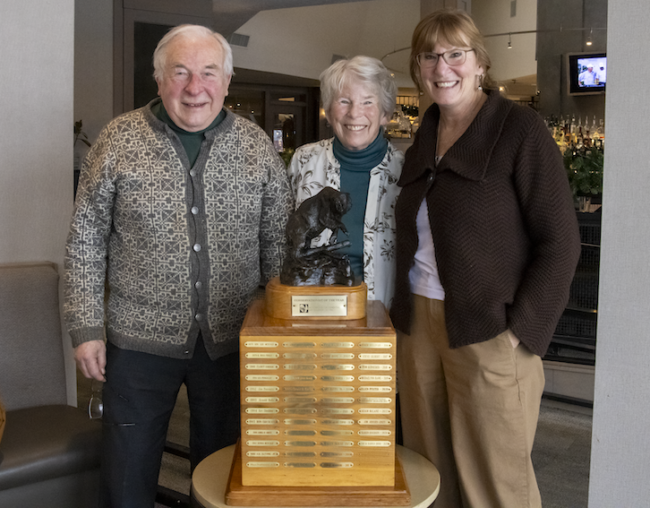
MEIC’s 2025 Conservationists of the Year, Harold and Jan Hoem, with MEIC executive director Anne Hedges.
by Katy Spence
On his 88th birthday, Harold Hoem gave public comments at a virtual Environmental Protection Agency (EPA) hearing about the agency’s rollback of air quality regulations for coal-fired power plants. Sitting at his side, as she has been for 65 years, Jan Hoem had her own set of comments.
As in many cases when Jan and Harold submit public comments, they draw upon their life experiences. Both are leaders of Montana Elders for a Livable Tomorrow (MELT), a close group in Missoula that focuses on climate action to help preserve a livable future for their children, grandchildren, and beyond.
For decades, Jan and Harold have advocated for clean air and clean water, and MEIC is honored to recognize them as 2025’s Conservationists of the Year.
The Early Years
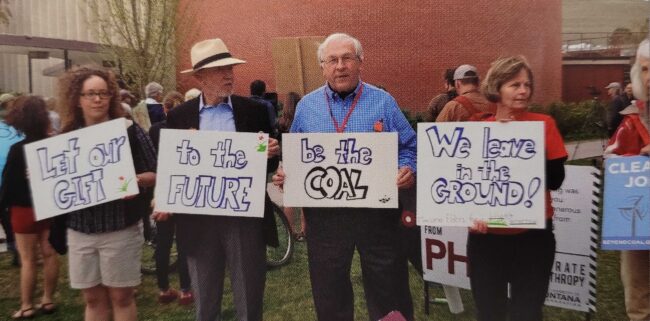
Harold, center right, joins a protest at the University of Montana. Opposite, Jan edits sound for “Coal Road to China.” Photos via Jan Hoem.
Harold was born and raised in Butte, America, working in the underground mines before the Berkeley Pit became a stain on the landscape. He attended college at the University of Montana and worked as a smokejumper for three years. When he moved to the University of Washington, mutual friends set him up on a blind date with Jan, a Washington gal, and they were married less than a year later. Their daughter, Marsha, was born in Butte.
During the early years of their life together, the Hoems lived and worked all over the world. While the small family was not always living in the same place, they were never far apart.
As a special agent for naval intelligence, Harold’s work took them around the world. For three years, they lived in Yokohama, Japan. When Harold was posted to Vietnam in 1967, Jan and Marsha moved to the Big Island of Hawaii where Jan taught and Harold could see them on his R&R.
The family then met up in Hong Kong and travelled west to Greece, where they lived and taught for two years.
“We both have always sought adventure,” Jan said, adding that they were always adventuring on a shoestring: renting a truck in Kenya for six weeks and tenting alone in wild areas (where Harold once stepped right over a cobra!); hiking in the Japanese Alps with Jan’s college conversational English students; visiting the remote areas of Hunza and Kafiristan with Marsha.
Jan said the fates have treated her family kindly, before sharing a story of falling in love with Scotland, where they lived for nine months before it was time to go home.
Commercial Fishing and Rural EMTs
Settling in the Seattle area, Harold bought a commercial fishing boat – a profession he had to learn on the job. They became a fishing family, fishing for albacore, halibut, and black cod. Jan continued to teach. Like so many who find their way to conservation work, being on the front lines of an extractive industry was eye-opening for the couple.
Harold’s Norwegian roots and love of the sea had instilled in him a strong sustainable fishing ethic, and he became involved with the Fishing Vessel Owners’ Association in Seattle to advocate against rampant over-fishing in the area. Harold helped get observers on fishing boats to help ensure that the fishermen, especially trawlers, weren’t wasting fish.
“That’s how we got involved in our first conservation efforts,” Harold said.
After 25 years, they decided to exit the commercial fishing industry. Harold built a small, cozy cabin in the North Cascades near Twisp, where Jan taught fifth grade and high school art, English, and Spanish.
“They had nobody who could speak Spanish, including me,” Jan said, as Harold laughed. She spent six weeks in Mexico learning Spanish to prepare.
While in Twisp, Jan and Harold joined the opposition to a large downhill ski development that would have drawn thousands to the area and changed the pristine landscape of what has now become a popular cross-country skiing destination.
 The couple also became volunteer EMTs and were often required to go above and beyond the call of duty. The two relayed a number of memorable experiences, from a man transporting his wife and her broken leg in a front-end loader to helping the rural ambulance driver navigate the busy roads of Seattle.
Their time as EMTs has been crucial to their work on climate change. They saw first-hand the suffering of people having acute asthma attacks and other conditions made worse by air pollution from wood stoves.
MELT & “Coal Road to China”
In the 1990s, Jan and Harold returned to Montana. While living on Georgetown Lake, they joined with other homeowners and Trout Unlimited to confront irrigators whose practices threatened to dewater the lake and endanger fish populations. By 1999, they had moved to Missoula.
One day, Jan heard an interview with author and climate activist Ross Gelbspan on the radio, and a spark was ignited. She wanted to learn more, so she called him. She told him that the future he described was not what she wanted for her children, and Ross replied that it was his own children’s futures that inspired him to write the book. Jan wanted to know how she could help, and Ross said, “If you can write and you can teach, why not publish a climate change newsletter?” With Harold’s help, Jan began a newsletter called “The Mercury’s Rising,” a quarterly publication that ran for three years and was sent to recipients in 16 countries.
During this time, Jan joined Missoula’s Air Quality Advisory Council (of which she has been a member for 17 years), and the two met Anne Hedges, MEIC’s longtime policy lead and current Executive Director.
In 2010, Jan and Harold attended a class about how human activities are negatively impacting Earth’s atmosphere. When someone asked “What are we going to do?” a group of like-minded seniors decided to meet, and Montana Elders for a Livable Tomorrow (MELT) has been meeting since.
Comprised of now-retired geologists, biologists, a professional chef, a former coal mine manager, educators, professors, medical professionals, a former legislator, and more, MELT is proud to boast “lifetimes of experience.”
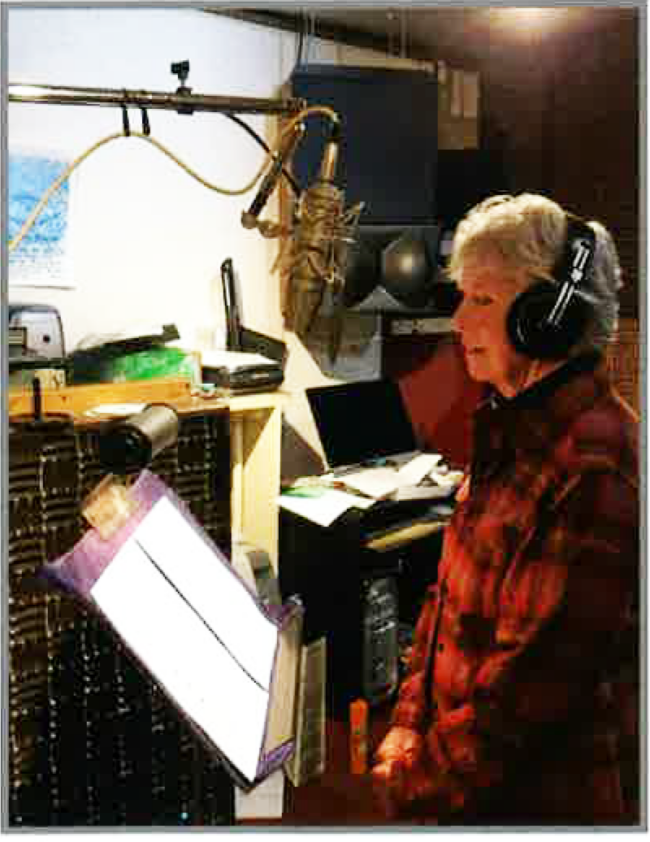 MELT’s largest and most challenging project was the making and showing of a film called “Coal Road to China,” in response to proposals to build five coal export terminals on the west coast. Coal would travel by train through communities across Montana, Idaho, and Washington and eventually be shipped to Asia.
Harold thought, “If you could see a place, maybe you would learn to love it.” Harold led the film crew (Jan, Harold, and MELT-er Ray Willms) on three trips to coal country in the Powder River Basin, filming Indigenous activists, ranchers, coal workers, and the coal mining process. Jan spent eight months creating a 35-minute film that can still be viewed on YouTube. They traveled around the Pacific NorthWest showing the film, bringing in speakers, and generating successful opposition.
Today, MELT is still about community, being involved in climate issues, and showing up. Jan said the members are like family.
Looking Forward
With a lifetime of experiences around the world and many years advocating for Montana, Harold and Jan are hopeful that we can move away from fossil fuels and create a healthier climate for the planet. Harold finds hope in international resistance to the U.S.’ policy backslides and in local organizations that can help activists do more.
“You can only do so much by yourself,” Harold said. “That’s why organizations like MEIC and MELT are so damn valuable. I know we’re on the right side of history here.”
With years of activism under their belts and no signs of slowing down, the Hoems are well-deserving recipients of this lifetime achievement award.
This article was published in the December 2025 issue of Down To Earth.