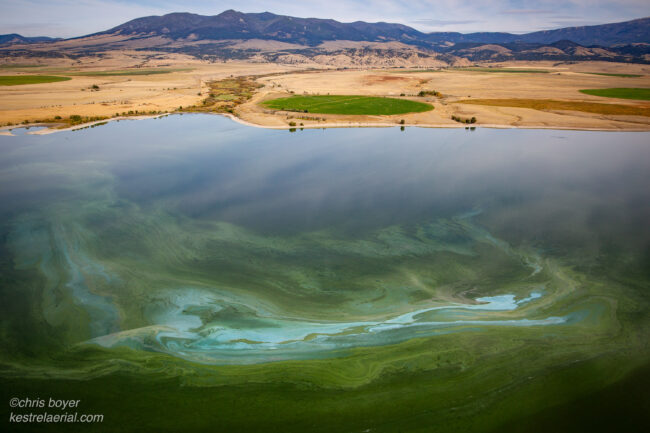
An algal bloom in Canyon Ferry by Kestral Aerial.
by Laura Collins
After years of trying — and failing — to replace Montana’s science-based numeric nutrient standards with subjective narrative standards, the Montana Legislature passed and the Governor signed HB 664 (Rep. Bill Mercer, R-Billings), despite MEIC’s strong objections. This bill repealed Montana’s numeric water quality standards for nutrients and replaced it with less protective narrative standards.
In October, the U.S. Environmental Protection Agency (EPA) changed its position and approved the repeal, accomplishing what municipalities and industry have worked towards for years: eliminating the state’s ability to use a numeric standard for measuring the amount of pollution that is discharged into our rivers and streams. Montana was one of the first states to adopt numeric nutrient pollution limits due to the decline in statewide water quality. Currently, Montana is the only state to go backwards from a strong standard to more subjective (and undefined) narrative limits and adaptive management plans.
The numeric standard was adopted in 2014 after close to a decade of stakeholder involvement. A large body of science was used to establish the correct water quality standards that would protect the beneficial uses of waterways, (e.g. swimming, drinking, and fishing), from the harms caused by excessive nutrients in the water such as algae blooms that choke out aquatic life.
Nutrients generally find their way into waterways through failing septic systems, lawn care, and agricultural runoff, known as “non-point source” pollution. They also result from “point source” pollution: discharges directly into waterways from municipal waste water treatment facilities and industries such as mining and refineries. DEQ’s numeric limits were initially approved by the EPA as an effective, evidence-based way to address point source nutrient pollution.
Previous attempts to change the standard were rejected by the EPA because they did not comply with the federal Clean Water Act. Unfortunately, the repeal is already leading to proposed weakening of limits on industrial wastewater permits. The Stillwater Mine, for example, just requested that DEQ increase its allowed nutrient pollution discharges from 0.2 ppm to 16 ppm – a nearly 6,000% increase which is certain to harm the East Boulder River.
With the elimination of science-based numeric limits, the EPA approved DEQ’s rollback with only a single, vague narrative rule (under Administrative Rule 17.30.637) which lacks clear procedures based on scientific guidance. This could be used by DEQ to make subjective, case-by-case permitting decisions with no scientific basis. While EPA’s October 2025 approval cited an expectation that rules would be developed to implement the narrative standard, permits changes are being proposed without those rules in place to protect water resources.
With more than one-third of Montana’s assessed waterways already impaired by nutrient pollution, this regulatory void undermines the state’s ability to prevent further degradation, protect public health, and sustain Montana’s clean water economy. Until DEQ adopts a transparent, science-based narrative framework, permitting nutrient discharges under the current system risks irreparable harm to the rivers, lakes, and streams Montanans depend on.
MEIC will be participating in rulemaking processes to help define the scope of the narrative standards. We will let you know when there are opportunities to help protect Montana’s waterways.
This article was published in the December 2025 issue of Down To Earth.