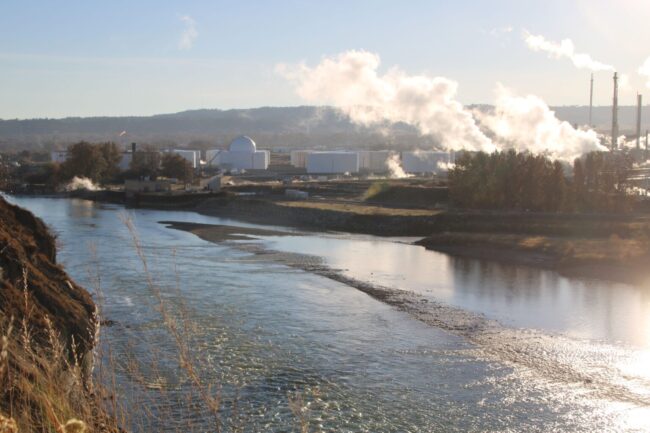
CHS Refinery in Laurel regularly fails water quality tests for its discharge into the Yellowstone River. Photo via Earthworks.
by Katy Spence
After years of MEIC and other watchdogs sounding the alarm, the Montana Department of Environment Quality (DEQ) has levied an inconsequential fine against the CHS Refinery in Laurel for releasing excess amounts of multiple types of pollution into the Yellowstone River.
The Billings Gazette reported in October that CHS failed 32 of 44 tests for excessive nitrogen and/or ammonia in its water pollution discharges from June 2021 to January 2025. These tests, which must be done at least once each month, measure the levels of nitrogen and/or ammonia in the wastewater that the refinery pumps into the Yellowstone River. While the tests only measure water on one day per month, it’s highly likely that CHS is dumping wastewater with excessive levels of harmful pollution all the time.
On September 24, DEQ published a consent order stating that CHS “had control over those permit violations, but did not take timely, reasonable precautions to prevent” the violations and made a point to say that CHS — a global business — should know better. The agency levied a $100,000 fine against the company, which it claims is the maximum allowed by state law.
Let’s be clear: $100,000 is less than a drop in the bucket for a company that reported $1.1 billion in net income from its $40 billion in revenue in 2024. At the federal level, the EPA is able to fine a company around $60,000 for each day that company is in violation of water quality standards and it assumes a company is out of compliance until it proves that it is back in compliance. This framework provides an incentive to come back into compliance quickly.
Montana has chosen a weaker path. It charges far less for each violation and assumes the violation only occurs on the one day the test was taken and not subsequent days, even if the next test is also in excess of the legal limit.
In addition, DEQ has known about CHS’ water pollution violations since at least 2021. While DEQ is responsible for issuing water pollution permits, it must also enforce the law when a company fails to comply with the state and federal Clean Water Act. Unfortunately, DEQ waited so long to bring an enforcement action against CHS’ pollution that it is unable to enforce every violation due to its arbitrarily short statute of limitations for such violations.
The Yellowstone River is an incredibly valuable resource for southeastern Montana, and the discharge point for CHS is directly upstream of Billings and other communities, increasing concerns about the cleanliness and safety of drinking water and fisheries.
To add insult to injury, this fine does not include consideration of the toxic levels of arsenic that the plant has been releasing into the Yellowstone River for years (see December 2022 issue of Down to Earth). MEIC is currently challenging DEQ’s reissuance of its wastewater permit to the refinery because of its continued, long-term failure to meet arsenic limits in the water it puts into the Yellowstone. The Yellowstone River deserves better than to be treated as a dumping ground for harmful and toxic pollution from refineries. The law doesn’t allow it and neither should DEQ.
This article was published in the December 2025 issue of Down To Earth.