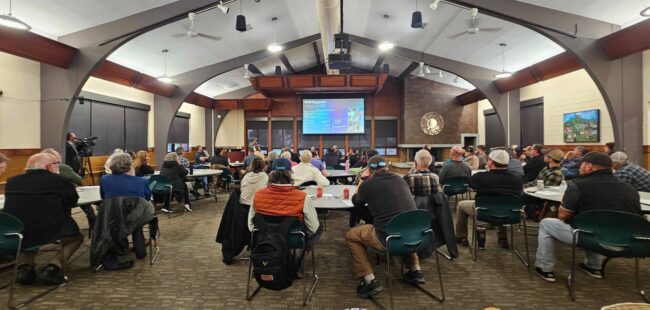
Over 70 people attended MEIC and our partner’s event on data centers in Butte.
by Ben Catton
Buttians are worried about data center development. On October 16, more than 70 people filled the Copper Lounge at Montana Tech in Butte to learn about the potential impacts of Big Tech’s plans for data center development in Silver Bow County.
The event, Beyond the Boom: Protecting Butte from New and Old Resource Pressures, opened with MEIC’s Anne Hedges discussing state and federal policies that incentivize data center development and are likely to raise electricity bills. Sarah Borduin, a Butte citizen organizer, took a hard look at a current data center operation in Butte as well as a proposed data center nearby. Butte resident Steve McGrath concluded the presentation by explaining how public engagement resulted in cleaner air for people in Butte. He shared how the Greeley Neighborhood Community Development Corporation, Inc., worked with MEIC to persuade Montana Resources to install dust control technology. McGrath emphasized that “a dedicated and unrelenting community effort can bring positive results.” A community discussion, moderated by Erik Nylund, podcaster at “Mad About Montana,” followed the presentations. The robust set of community questions were submitted to the Butte-Silver Bow County Commission for a written response. (The full event can be viewed on MEIC’s YouTube channel.)
Data centers are massive warehouses of computers. Montana’s proposed data centers are called “hyper-scale projects” and demand enormous amounts of power and water. The two data centers discussed by the panel could consume 400 megawatts (MW) of electricity – enough to power over 300,000 homes. For comparison, NorthWestern Energy currently supplies about 750 average MW to its entire Montana customer base.
Large data centers also need an enormous amount of drinking-quality water. A single data center can consume up to five million gallons of water daily, a volume comparable to the water usage of a town of up to 50,000 residents. The proposed data center in Butte recently admitted it would use up to three million gallons of water a day. The audience questioned where that water would come from and in a drought, what would happen to fish, wildlife and senior water users.
Proponents have mentioned the possibility of nuclear energy supplying data centers with electricity, but this is likely a red herring. The supposed new generation of nuclear power plants, referred to as small modular reactors (SMRs), will take at least a decade to build – not within a timeframe that could power these energy-hungry data centers. In addition, nuclear power is currently the most expensive generation available, and SMRs in development are proving to be similarly unaffordable (with staggering tax payer subsidies).
The panelists stressed that transparency and regulations are needed to ensure that promises made by Big Tech’s salespeople, utility CEOs, and politicians are backed up in writing. It is essential that our elected officials at the Public Service Commission (PSC), in our local governments, and at the Montana Legislature restore balance in our regulatory relationship with data centers — before it’s too late. MEIC is engaging local communities in this fight, and we are holding the PSC accountable to their role in protecting Montana’s energy customers. People in Montana deserve elected officials who will stand up for them, not out-of-state tech companies who can afford to pay their own way.
This article was published in the December 2025 issue of Down To Earth.