by Shannon James
This spring, many Montanans experienced a familiar and unwelcome sense of déjà vu. A new tar sands pipeline proposal has surfaced, presenting the same risks, the same promises, and the same troubling lack of transparency that defined the fight over the Keystone XL pipeline: the Bridger Pipeline, often dubbed “Keystone 2.0.”
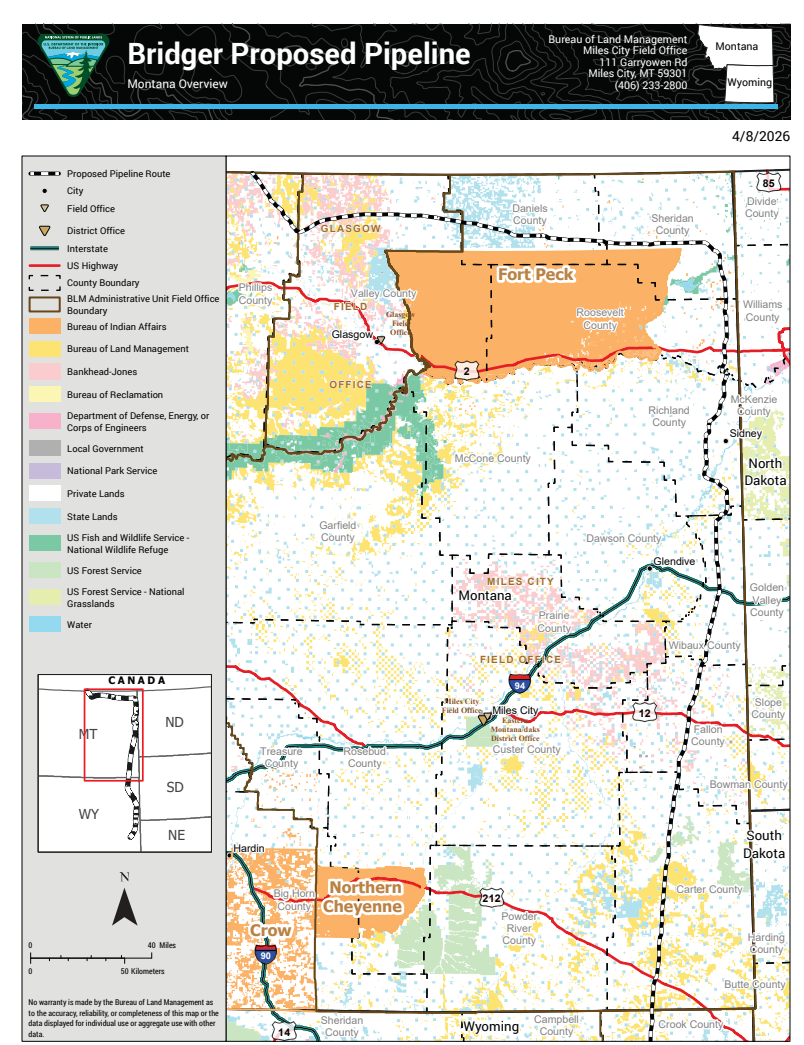
The Bridger Pipeline would carry crude oil from Alberta, Canada, south through eastern Montana into Wyoming, terminating in Guernsey (see map below). While the company initially refused to disclose the type of oil it plans to transport, it later confirmed what many suspected: this pipeline is designed to carry tar sands oil, one of the dirtiest and most environmentally destructive fuel sources on the planet. The company also noted it plans to find a partner to build a subsequent line to either Cushing, Oklahoma, or to the Gulf Coast.
Montana stands to bear the brunt of this project. Unlike Keystone XL, the majority of this pipeline would run through our state, placing our land, water, and communities directly in harm’s way — all for the benefit of filling the pockets of big oil.
And the risks are not abstract.
The Bridger pipeline could transport up to 1.13 million barrels of oil per day, surpassing Keystone XL’s capacity. Yet critical details including the pipeline’s full route, end destination, and ultimate use of the oil were omitted from the application submitted to state and federal agencies. Without this information, regulators and the public are being asked to evaluate a project without understanding its full scope or consequences.
Transporting tar sands oil introduces additional dangers. Tar sands contain bitumen: a thick, heavy, and viscous form of petroleum. This raw bitumen must be mixed with lighter petroleum products to make it flow through pipelines. The consequences of a spill are higher because bitumen can sink in water and mix with sediments, making cleanup more challenging and more expensive.
Spills are not hypothetical. Pipeline failures are inevitable over time. True Companies, the parent company behind Bridger, has already been responsible for major incidents, including a 50,000-gallon spill into Montana’s Yellowstone River in 2015 and another 45,000-gallon spill in Wyoming in 2022. For a state whose economy depends heavily on agriculture, hunting, and fishing, even a single spill from the Bridger pipeline could have devastating and long-lasting consequences.
The proposed route only heightens these concerns. The preferred alignment would cross three major Montana rivers (the Yellowstone, the Missouri, and the West Poplar) and intersect streams and waterways more than 150 times on federal lands alone. These are not just lines on a map; they are lifelines for communities, farms, and wildlife.
The construction methods themselves carry risks. The project would rely heavily on horizontal directional drilling (HDD) for placing underground pipes, a technique often marketed as less disruptive but far from risk-free. HDD can result in “frac-outs.” Frac-outs from horizontal drilling are not caused by fracking but are uncontrolled releases of drilling fluids that can pollute waterways, smother aquatic life, and migrate unpredictably underground.
Beyond water risks, the pipeline threatens air quality, public health, and fragile ecosystems. Construction would bring increased emissions, heavy equipment, and widespread land disturbance. Sensitive habitats would be disrupted, and already vulnerable species — including whooping cranes, northern long-eared bats, pallid sturgeon, and sage grouse — could face further decline.
There are also profound impacts on Tribal Nations. The pipeline corridor cuts through areas of cultural, historical, and ongoing importance, including unceded hunting territories. These environmental concerns are also issues of sovereignty, heritage, and treaty rights.
And looming over all of this is the climate crisis.
Expanding tar sands infrastructure is fundamentally incompatible with any serious effort to address climate change. This project would drive increased oil extraction, transportation, and combustion, resulting in significant greenhouse gas emissions at every stage. Tar sands crude is especially carbon-intensive, requiring more energy to extract and refine than conventional oil. At a time when communities across Montana are already experiencing the impacts of drought, wildfire, and shifting ecosystems, this project moves us in exactly the wrong direction.
Despite the magnitude of these risks, the project is being fast-tracked. In April, the Trump Administration approved a Presidential Permit for the pipeline’s international crossing without conducting an environmental review or consulting Tribal Nations. Meanwhile, the Bureau of Land Management and the Montana Department of Environmental Quality are moving forward with an environmental review process that remains incomplete, even as key project details are still being developed.
Agencies have indicated there may be limited opportunities for public input, including a short comment period on the forthcoming draft Environmental Impact Statement. But meaningful public participation requires more than a procedural checkbox; it requires transparency, time, and a genuine willingness to consider the full range of impacts.
Montanans have been down this road before. We know what is at stake.
The Bridger Pipeline is all risk and no reward for our state. It asks us to endanger our rivers, our livelihoods, our wildlife, and our climate so that the most dangerous type of oil can pass through Montana on its way to distant markets. We are being treated as a corridor, not a community.
We cannot afford to repeat the mistakes of the past. Montanans deserve a full and honest accounting of this project’s impacts, robust public engagement, and decision-making that prioritizes the health of our land and people over corporate profit.
This article was published in the June 2026 issue of Down To Earth.