by Shannon James
Last May, the Trump Administration signed a series of sweeping executive orders aimed at catapulting the nuclear industry forward. Buried beneath the rhetoric of innovation and energy independence is a troubling reality: federal agencies are quietly rewriting nuclear safety and environmental rules to meet an impossible political deadline, and they are doing it largely out of public view.
The goal set by the executive orders is staggering. The Secretary of Energy must approve at least three new nuclear reactors by July 4, 2026. A timeline of 13 months defies decades of experience in nuclear construction, safety protocols and regulation. To make the impossible appear achievable, the administration has chosen to strip away safeguards, sidestep public oversight, and rush high-risk technologies to market.
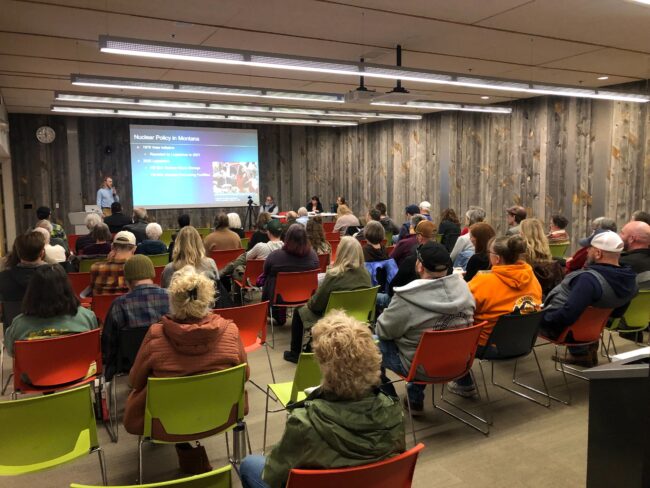
MEIC’s Nick Fitzmaurice speaks to a crowd in Billings about nuclear policy. Other speakers included Clint McCrae, Krystal Two Bulls (Honor the Earth), and MEIC’s Shannon James. Photo by Katie Harrison.
The Department of Energy (DOE) is now overseeing a reactor pilot program that fast-tracks new reactors without requiring licenses from the Nuclear Regulatory Commission (NRC), the independent agency created specifically to regulate civilian nuclear safety. Instead, DOE will authorize the reactors using internal departmental orders. Historically, those orders applied to a limited number of government-owned reactors used for weapons and research. Now, DOE is expanding its orders to cover commercial reactors and rewriting its rules at the same time.
DOE has quietly slashed hundreds of pages of nuclear safety, security, and public health and environmental requirements, sharing draft versions directly with regulated companies before releasing them to the public. According to an NPR analysis, more than 750 pages of protections were eliminated, leaving roughly one-third of the original requirements intact.
Among the most troubling changes:
- The long-standing radiation safety principle ALARA (“As Low As Reasonably Achievable”) was removed;
- The requirement to protect water resources from contamination was replaced with vague, unenforceable language that says they have to “consider avoiding” contamination;
- Specific security mandates including training standards, emergency drills, work-hour limits, and physical safeguards were consolidated or eliminated;
- Requirements for designated safety engineers, independent oversight, and detailed record-keeping were cut back or removed entirely.
These changes were made without public notice, without a public comment period, and without transparent justification. Former regulators, nuclear engineers, and public-interest scientists warn that this rollback not only increases risk but also undermines public trust in nuclear safety. To further shut out public scrutiny, DOE announced that new reactors would be exempt from review under the National Environmental Policy Act (NEPA).
Among the 10 companies selected for the new Reactor Pilot Program is Oklo Inc., whose prior application was denied by the Biden Administration. At the time, an NRC official reportedly described it as “probably the worst application the NRC has ever had,” citing the company’s failure to provide verifiable evidence addressing even basic safety questions. Despite that history, Oklo has broken ground on its Aurora reactor in Idaho, and the DOE approved its Nuclear Safety Design Agreement last fall.
The Aurora reactor is a sodium-cooled fast reactor, a design that produces highly energetic neutrons requiring extensive shielding to operate safely. DOE’s newly weakened rules allow for reactors to be built with less concrete shielding. Edwin Lyman, a physicist and director of nuclear power safety at the Union of Concerned Scientists, warns, “If something goes wrong, the potential for a Chernobyl-like escalating event is actually much higher than it is with light-water reactors.”
And if that weren’t enough, the NRC itself is preparing revisions to its radiation protection standards, which apply across the entire nuclear industry. Advocates expect these changes to further weaken protections for workers and the public and to align NRC standards more closely with DOE’s newly diluted rules.
Every phase of the nuclear fuel cycle releases radiation. Without proper regulation and prevention, these facilities may expose nearby communities to dangerous amounts of radiation, which can increase the likelihood of cancer, birth defects, impaired brain development, and disorders of the reproductive, cardiovascular, endocrine, and immune systems. Women and children face especially high risks.
This deregulatory push is not happening in isolation. It is part of a coordinated effort to make nuclear deployment faster and cheaper for the industry by lowering safety standards. In fact, the feds are now offering incentives to states who accept nuclear waste. With reactor development accelerating and long-term disposal still unresolved, the Trump Administration appears ready to offload responsibility onto states, many of which lack the resources, expertise, or political leverage to refuse. Communities could soon find themselves hosting radioactive materials without robust environmental review, strong radiation limits, or meaningful consent.
Approving reactors in “three weeks,” as the president reportedly promised Silicon Valley executives, may thrill investors. It should terrify everyone else. Many of these so-called “advanced” reactors exist only on paper. They have never been built, never operated, and therefore never have had a chance to fail, which means their risks are not fully understood. That is precisely when strong oversight matters most.
There is so much happening around nuclear right now because the Trump Administration is racing the clock and hoping the public doesn’t notice. But people are paying attention, and we must speak up. MEIC will continue to share information about public comment periods on proposed changes to nuclear safety standards. Our voices still matter if we use them.
This article was published in the March 2026 issue of Down To Earth.