by Nick Fitzmaurice
NorthWestern Energy released its draft Integrated Resource Plan (IRP) in January, outlining a 20-year plan for Montana’s electricity system that relies heavily on expensive coal, gas, and nuclear generation. While NorthWestern is supposed to plan for a least-cost energy future, it’s apparent that maximizing profits at the expense of customers took priority — again. The public turned out in force to NorthWestern’s four public meetings in January and February to push back on this expensive and out-of-touch plan.
Whether or not NorthWestern updates its IRP in response to the public’s legitimate concerns, raising these concerns is crucially important. NorthWestern’s executives appear to be using the IRP to justify investing in the most expensive types of power plants available, but we have an opportunity to set Montana on a different course. NorthWestern will file its final IRP with the Public Service Commission (PSC) at the end of April, kicking off a 120-day review period at the PSC that will include a 60-day public comment period and another round of public meetings. If NorthWestern doesn’t address the public’s concerns about its IRP, then we will take those concerns to the PSC.
In 2023, PSC staff took the public’s concerns seriously and recommended that the Commission issue a strong critique of NorthWestern’s previous IRP. The final critique was watered down at the last minute by the Commissioners, but still contained important directives for NorthWestern to do better. While the 2026 plan remains deeply flawed, it contains improvements compared to the 2023 IRP. Ultimately, the final IRP, and the Commission’s feedback, will influence whether NorthWestern conducts a request for proposals (RFP) for new electricity resources, and what types of power plants NorthWestern eventually builds. A flawed 2019 IRP and subsequent defective RFP led to the construction of the Yellowstone County Generating Station (YCGS) gas plant near Laurel. Those flaws gave the PSC reason to deny part of NorthWestern’s request to charge ratepayers for all the costs associated with YCGS. Strong public concerns about NorthWestern’s current plan should cause the utility to think twice before making this mistake again.
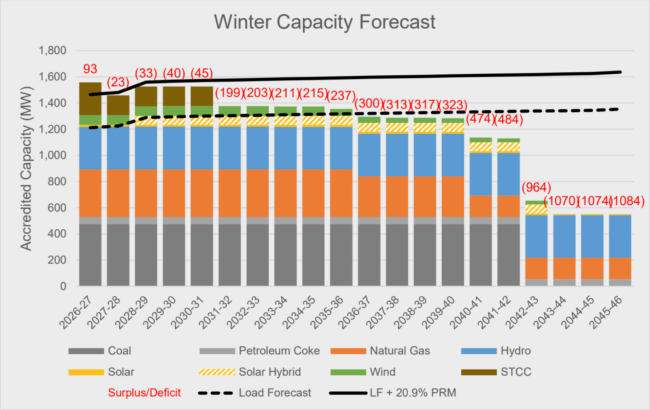
NorthWestern Energy overinflates how much electricity is needed — and underestimates the efficacy of solar and wind — to justify building more fossil fuel plants. In this graph, LF: Load Forecast; PRM: Planning Reserve Margin; and STCC: Short-term capacity contract. Graph via NorthWestern Energy’s 2026 Draft IRP.
The IRP is a recurring modeling exercise for NorthWestern’s future electric system. The information used to create this model (assumptions, inputs, constraints, and goals) have tremendous influence over the outputs the model generates. This iteration, NorthWestern created a model that hamstrings low-cost wind and solar, establishes extraordinary and unjustified needs for new generation infrastructure, and makes outrageous cost assumptions around the Colstrip plant, concluding that any scenario involving early plant retirement would lead to more costs for customers. But this analysis was pre-baked, and NorthWestern purposefully excluded all the ingredients for a truly least-cost electricity portfolio. If you put a frozen pizza into the oven, you’re not going to pull out a wedding cake 20 minutes later.
MEIC has been sifting through the details to distill some of the key modeling assumptions that led to NorthWestern’s skewed IRP outcomes. Here are a few that have risen to the top:
Casting Wind and Solar Aside
NorthWestern almost completely excludes low-cost wind and solar from its 20-year planning scenarios through arbitrary model configurations. It undervalues these resources’ output during peak electricity demand, and ignores their ability to provide reliable and complementary electricity when built together and combined with short- and long-duration energy storage. This is exacerbated by NorthWestern’s artificial constraints on using short- and long-duration energy storage. Meanwhile, NorthWestern drastically overestimates the reliability of its coal and gas resources, including the Colstrip power plant, despite these fossil fuel power plants’ demonstrated equipment failures and fuel supply shortages during extreme weather events.
NorthWestern further undervalues wind and solar by tacking on exorbitant, unrealistic costs for connecting these resources to the grid, ignoring their ability to replace retiring power plants and their availability in a fraction of the time it takes to construct other, more expensive resources. And NorthWestern used cost assumptions for wind, solar, and battery storage that dramatically exceed standard industry estimates. Simply put, NorthWestern doesn’t give these resources a chance.
Inflating Capacity Need
NorthWestern’s IRP envisions supplying enough capacity to meet peak electricity demand on the most extreme weather days of the year. This is the maximum instantaneous flow of electricity through NorthWestern’s system at any given time, not to be confused with the total energy delivered to customers over the course of a year. How NorthWestern defines this capacity need, and what avenues are considered for supplying that capacity, are crucially important.
Despite having far more power than customers need because of YGCS and additional Colstrip shares (see articles on pg. 9 and 16), NorthWestern says that it faces a capacity deficit in the near future. However, this is largely driven by the expiration of contracts with existing renewable energy resources that NorthWestern doesn’t want to extend. It instead plans to build expensive fossil and nuclear generation when those contracts expire. NorthWestern also uses an outrageous, black box “planning reserve margin” to say that it needs to build 21% more capacity than its peak need (see graph on opposite page). And as NorthWestern kowtows to out-of-state data center developers, it sees an opportunity to inflate its capacity needs even further.
NorthWestern ignores the cheapest forms of capacity, such as demand-side management measures to reduce or shift certain electricity use during periods of peak demand. Smart meters, such as those already installed by NorthWestern and paid for by customers, can help facilitate this balance, but NorthWestern ignores these opportunities. NorthWestern also doesn’t factor in the ability of interregional transmission to provide capacity during peak events. On top of everything, the IRP fails to model the costs and benefits of NorthWestern’s participation in one of two competing energy markets for coordinating energy trades, especially during these high demand periods. Consideration of these factors would prevent NorthWestern from building expensive power plants to serve customers for the handful of days a year when demand is highest.
Ignoring Climate Change

Many folks at Missoula’s IRP hearing spoke about rising electricity costs and data centers. Photo by Shannon James.
Despite the increasingly apparent impacts of a changing climate on Montana’s energy system and NorthWestern’s constitutional obligation to consider climate change, no scenario in the utility’s IRP is in line with NorthWestern’s “Net Zero by 2050 Vision.” In fact, climate change is only mentioned once in the entire 332-page draft, in reference to stakeholders’ voiced concerns about climate change. While planning to continue exacerbating the climate crisis, NorthWestern includes no climate resiliency and adaptation planning in the IRP.
Creating Barriers to Transparency and Public Participation
MEIC’s ongoing efforts to guard and expand transparency and public participation in the IRP process have achieved marginal improvements, but NorthWestern continues to impede a truly transparent and collaborative process.
NorthWestern’s stakeholder groups and public meetings were just forums for NorthWestern’s planning team to relay what the company’s executives had already decided to do. As a result, the final IRP doesn’t represent a least-cost resource planning exercise, but instead a fossil-fuel-guzzling cash-cow for NorthWestern’s executives and shareholders.
MEIC’s IRP webinar discussing these and other major deficiencies as well as our full comments to NorthWestern, can be accessed from MEIC’s website.
This article was published in the March 2026 issue of Down To Earth.