by Nick Fitzmaurice
Without increasing electric transmission connectivity across the West, clean energy projects like wind and solar cannot be plugged into the grid, and clean energy electrons cannot be delivered to households and businesses. At a time when lawmakers are pushing for a return to fossil fuels, transmission development still enjoys bipartisan political support. Working to overcome obstacles for transmission development, MEIC helped fund a study by the independent energy consulting firm Energy Strategies to examine transmission needs for improving Montana’s connection to other states in the West.
Montana has the second-highest potential for wind generation and fourth-highest potential for solar generation in the entire country, making it possibly the best western state for low-cost renewable energy development. It has historically been an energy exporter, bringing significant economic benefits to the state. Montana’s renewable energy potential could help continue this beneficial legacy.
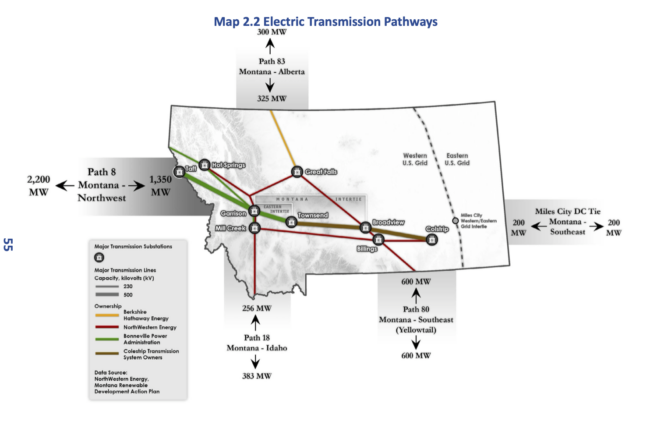
The Montana Transmission Connectivity Study was intended to analyze transmission needs to improve connectivity on the state’s most congested transmission pathways: Path 18 into Idaho and beyond, and Path 8 into the Northwest. Improving regional transmission connectivity across these pathways will not only improve Montana’s access to clean, affordable, and reliable energy in the region, but it will also bolster clean, reliable, and affordable energy for the entire Western electric grid. Transmission development can be expensive on the surface, and allocating costs for regional projects across jurisdictions can create massive headaches. However, the U.S. Department of Energy has estimated that every dollar invested in expanding the transmission system can create between $1.60 and $1.80 in overall system benefits, with others estimating those benefits as high as $4.70 per dollar spent. (Check out MEIC’s Transmission Factsheet on our Resources webpage for further reading on transmission as a clean energy solution.)
The study, which was completed this fall, explores phased transmission expansion to accommodate three incremental levels of additional energy moving through Montana’s system over the coming decades: 3 Gigawatts (GW) in a Low Deployment Scenario, 9 GW in a Medium Deployment Scenario, and 12 GW in a High Deployment Scenario (a gigawatt is a thousand megawatts). For each of these scenarios, the modellers at Energy Strategies developed a digital model of Montana’s existing transmission system, incrementally adding energy development onto the system up to the total deployment for each scenario. When the model identified any part of the transmission system violating a physical limitation, a transmission solution was implemented to address the violation. Each scenario builds off the transmission needs identified in the previous, lower resource development scenario, creating an incremental roadmap for transmission development in Montana for enabling a clean, affordable, and reliable energy future in the state.
While the study identifies specific transmission projects for consideration, the lines included in the study are provisional. The task of mapping out specific corridors and developing real transmission projects must center the concerns of the communities where these projects will take place and cannot be achieved through a planning exercise on paper. But this kind of study does serve as a beneficial starting point. The following key findings will help MEIC and other study sponsors prioritize future engagement in transmission planning and development.
Montana’s transmission system is already constrained under current conditions.
Capacity on existing interstate transmission paths, including the Colstrip system, Montana-Northwest, and Montana-Idaho corridors, is fully allocated. Without new infrastructure, even modest amounts of incremental generation is not possible.
Phased transmission investments allow Montana’s grid to scale with resource growth and market demand.
The study identified a series of coordinated transmission upgrades that enable incremental resource additions over time. This phased approach avoids overbuilding, aligns infrastructure with evolving generation and market dynamics, and preserves flexibility under future uncertainty.
A new Montana-Idaho transmission line provides a high-impact starting point.
For the Low Deployment scenario, a new High-Voltage Direct Current (HVDC) line between the Colstrip transmission system and Idaho, paired with minor upgrades in Montana, offers an efficient solution for beginning to unlock interstate connectivity and associated system-wide affordability and reliability benefits.
Montana transmission expansion can integrate with other major regional transmission projects.
The transmission portfolios identified in the study complement and connect to major planned transmission projects, such as Gateway West, Boardman-to-Hemingway, SWIP North, and the North Plains Connector (NPC). Together, these projects support a stronger, more resilient regional grid.
A mix of technologies maximizes system performance and limits land impacts.
The transmission portfolios include a mix of HVDC, advanced conductors, reconductoring, and flow-control technologies that increase efficiency and flexibility to maximize existing infrastructure while minimizing the need to obtain new rights-of-way.
Tribal collaboration is essential for future corridor planning.
Current datasets are insufficient to properly incorporate Tribal preferences and culturally-sensitive areas into routing; deeper, direct coordination with and informed consent from Tribal nations is needed to identify preferred corridors.
A list of key findings, along with the Montana Transmission Connectivity Study, is on MEIC’s website.
This article was published in the December 2025 issue of Down To Earth.