Could Geothermal Energy Power the Future?
Geothermal energy is often left out of clean energy discussions, but as technological developments advance, the possibility of harnessing thermal energy in the Earth for widespread commercial use is garnering more attention.
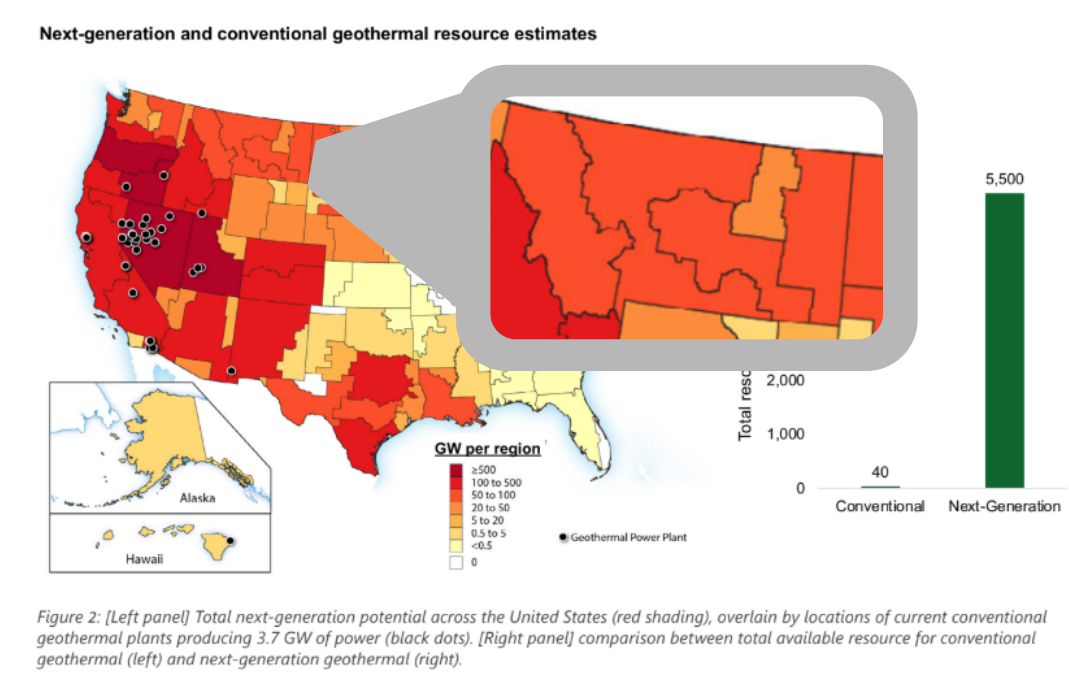
Historically, geothermal energy has been concentrated in only six states in the U.S. that have near-surface geothermal activity suitable for cost-effective heat extraction at temperatures high enough for electricity generation: Oregon, Idaho, California, Nevada, Utah, and New Mexico. Traditional geothermal technology provides limited potential for additional cost-effective geothermal development, but recent technological advancements could expand the geothermal opportunities tremendously.
In 2023, existing low-carbon geothermal energy supplied just 0.4% of electricity demand in the U.S. With enhanced geothermal systems, the Department of Energy in 2024 predicted that this number could climb to 12% by 2050 if not higher.
Use these links to jump to a section:
What is Geothermal Energy?
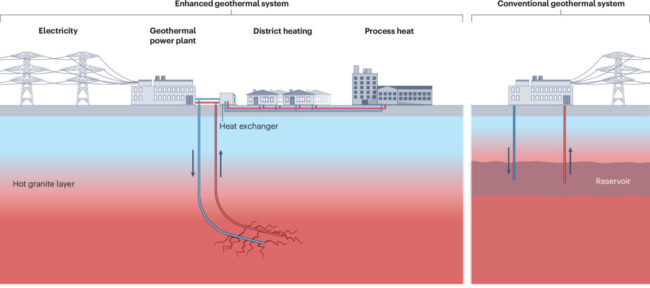
Broadly, geothermal energy refers to physical infrastructure that extends underground into the earth’s crust to access the natural heat that occurs at certain depths. This heat is closer to the surface and requires shallower drilling in some parts of the earth than others.
Drilling technologies and practices have improved dramatically over the past 20 years of oil and gas development, presenting a renewed wave of possibilities for transferring those improvements to low-cost geothermal development.
Click here to go back to the top.
**************************************************
Traditional Geothermal Power Generation
The first traditional geothermal power generation source was built in 1904 in Tuscany, Italy. This form of power generation is confined to limited geographic regions where near-surface geothermal activity allows for easy and cost-effective harnessing of the earth’s heat to produce power. Traditional geothermal power uses vertically drilled wells to access the earth’s heat with three basic power plant types:
- Dry Steam: Steam is used directly from a compatible geothermal reservoir to power a generator – the first geothermal plants were dry steam plants.
- Flash Steam: Highly pressurized hot water from deep underground is converted to steam to drive a generator, then condensed to water and injected back into the ground – most existing geothermal plants are flash steam.
- Binary-cycle: Heat is transferred from geothermal hot water to a second liquid, which turns to steam and drives a generator. This is the predominant technology for enhanced geothermal systems, given its suitability at lower relative temperatures.
Click here to go back to the top.
**************************************************
Enhanced Geothermal Energy Systems (EGS)
This MEIC webinar featured Dr. Roland Horne, Thomas Davies Barrow Professor of Earth Sciences at Stanford University and Director of the Stanford Geothermal Program who explained the differences between traditional geothermal technology and the enhanced geothermal systems that are making headlines today.
The goal of enhanced geothermal systems is to access the ever-present heat beneath our feet virtually anywhere, while keeping costs competitive with other power generation sources.
Excitement over this prospect has simmered for decades, and it appears that the technology is finally beginning to deliver. Fervo Energy is leading the charge with its 3.5 MW pilot project (Project Red) that came online in Utah in 2023. Construction is underway for its first full-scale facility (Cape Station Project), slated to come online in two phases in 2026 and 2028. The first phase will be 100 MW, with the full facility reaching 500 MW. Fervo already has other projects in the works, while numerous other companies simultaneously develop their own enhanced geothermal technologies.
What separates enhanced geothermal from traditional geothermal lies largely in the drilling practices. If you dig deep enough into the earth, you will find heat, but drilling to depths of 10,000 to 15,000 feet or more is no simple task. Enhanced geothermal energy developers are borrowing and adapting technological drilling breakthroughs from hydraulic fracturing (fracking) to cost-competitively access the heat at these depths.
Specifically, one of the major challenges with achieving geothermal viability is achieving a great enough flow volume of heated water to be able to power an electric generator at low cost. Drilling time can amount to as much as half the costs of a given geothermal power plant, and that’s one area where new technology is making tremendous strides. Fervo utilizes a different kind of drill bit to drill more quickly and effectively to deeper depths, reducing drilling time from as many as 60 days down to less than 20 days, slashing drilling costs. They also utilize horizontal drilling practices paired with hydraulic fracturing so that injected water has more hot rock surface area from which to pull heat.
With these successes, Fervo is bringing down the cost of its electricity substantially. While exact cost numbers are sometimes withheld as trade secrets, Nevada Power Company includes one of Fervo’s proposed projects in its 2025 IRP at $107/MWh. NorthWestern’s newly built Yellowstone County Generating Station has been estimated to cost anywhere from $121/MWh to $178/MWh, depending on how often it operates and the final price NorthWestern is allowed to charge customers for the plant. Developers are targeting $60-$70/MWh for unsubsidized competitiveness with other generation sources, with a 2035 Department of Energy target of bringing down costs of EGS to $45/MWh. At current prices, enhanced geothermal can be competitive with existing fossil generation. If costs decline in line with projections, geothermal may become cost-competitive with other low-cost renewables as well.
Other companies are entering this race for affordable, clean geothermal energy as well. For example, Quaise is exploring a new way of drilling super deep geothermal wells using millimeter waves in place of a drill bit to vaporize rocks. Another startup, Eavor, is implementing a strictly “closed-loop” piped technology in its geothermal wells. While other EGS companies re-cycle their injected fluids in near-closed systems, some fluids can be lost in underground pore spaces. However, critics of this purely “closed-loop” technology argue that there are major thermodynamic disadvantages to piping fluid past hot rocks rather than passing fluid directly over hot rocks. These companies and others are developing new electricity generation systems that could have profound impacts on achieving clean energy systems.
Click here to go back to the top.
**************************************************
Is Geothermal “Renewable?"
Yes and no. Geothermal energy is a low-carbon energy source and is derived from the renewable heat created deep underground. However, geothermal wells tend to extract heat at a rate greater than it can be replenished by the decay of naturally occurring radioactive elements deep in the earth’s crust and mantle. Power plants are generally designed to be more or less depleted over the 30-year economic life of a power plant. However, over a time horizon closer to 100 years, these temperatures will naturally renew.
A recent International Energy Agency (IEA) report on geothermal energy estimated that while geothermal currently meets less than 1% of global energy demand, the technical potential for geothermal electricity generation globally is approximately 600 terawatts (TW) at depths up to 26,000 feet, enough to meet global electricity demand 200 times over (for direct heating purposes, the technical potential is 320 TW). Of that technical potential, the economically feasible “market potential” is estimated at 800 Gigawatts (GW), or enough to supply over a quarter of global electricity demand. For reference, NorthWestern Energy’s Montana service territory uses an average of 760 Megawatts (MW), or 0.76 average GW. If developers can continue bringing costs down and proving their technologies, enhanced geothermal could very well be a key player in the clean energy transition.
Another benefit of geothermal energy is its ability to draw on existing technologies and skilled labor from the oil and gas industries. In fact, the IEA estimates that approximately 80% of skills, techniques, and equipment can cross over between geothermal and the oil and gas industries. Sixty percent of Fervo’s employees used to work in oil and gas, including its CEO. In this potentially disruptive clean energy transition, this is a major opportunity for quality, high-skilled re-employment for existing oil and gas workers with minimal retraining requirements.
Click here to go back to the top.
**************************************************
Environmental concerns with drilling geothermal wells?
We should be cautious in applying fracking technology for a clean energy solution. However, early projects indicate that environmental concerns for enhanced geothermal energy are minimal.
Chemical injection?
While hydraulic fracturing for oil and gas involves the injection of chemical-treated water into the earth, the technical characteristics of enhanced geothermal drilling require minimal use of chemical additives. Since EGS needs to achieve high flow rates of heated water, larger bore holes bypass the water viscosity constraint that reduces pressure in smaller-bore oil and gas drilling operations and necessitates chemical additives. Since EGS maintains constant well pressure by cycling water through its bore holes, there is less need for injecting fluids to prop up a fracture, such as is necessary when pulling oil and gas mass out of the earth. The Geothermal Sustainable Development Pact also includes an industry commitment to eliminate bioaccumulative substances (including PFAS), to use additives sparingly and at the lowest effective concentrations, and to publicly disclose any injection additives used.
Water usage
Water usage is a valid concern for geothermal energy that must be mitigated appropriately. Luckily, water contamination is a smaller concern compared to fracking since harmful chemicals aren’t added to the injection. But water consumption remains a concern. When water is injected for heat recovery, some of that water can remain underground, or cooling towers for flash steam and dry steam plants can also lose water to the air in the form of steam. This presents a challenge for using potable water in water-strained areas. However, non-potable water is also viable for use in EGS, such as the water Fervo is using for its Utah project. While Fervo doesn’t consider its systems to be truly “closed-loop” because their injection water isn’t contained in pipes, their use of binary-cycle generation means that hot water’s energy is transferred to a working fluid and then reinjected without the need for cooling towers. This means only minimal water would be lost through injection. Fully closed-loop geothermal projects could also be used to eliminate the need for replacement water in a system. Finally, since EGS is accessing heat at depths far below any drinking water sources and is avoiding existing super-heated water reservoirs, there is minimal risk of drilling operations coming into contact with drinking water sources.
Induced seismicity
There is some potential for earthquakes to be triggered by hydraulic fracturing. Industry has learned how to minimize these risks over the years, while current developers are taking this a step further by conducting smaller incremental fractures (multistage stimulation), rather than the traditional and more volatile approach for massive hydraulic fractures. Proper safety standards and precautions around seismicity are still necessary.
Life-cycle impacts
A major benefit of geothermal energy is the limited material resource demand of the technology. While traditional fossil resources (and nuclear) require a full supply chain for constant fuel supplies to generate power, the energy for geothermal plants is drawn on site without consuming any fuels. The power plant itself also uses minimal to no critical minerals. This makes geothermal a great resource for localized energy security and eliminates dependence on imported fuels and minerals.
Greenhouse gas emissions
Just like every source of electricity, construction of a geothermal power plant will have a greenhouse gas footprint as long as materials used in construction have embodied carbon and heavy equipment used in construction consumes fossil fuel (i.e. diesel). However, the generation of geothermal power itself doesn’t involve combustion of fossil fuels and therefore does not emit greenhouse gases. Leading developers have also implemented zero-emission geothermal power-plant construction and drilling operations by electrifying their heavy equipment. There is the potential for some naturally occurring gases to be released from underground reservoirs in traditional dry steam and flash steam drilling processes, but that potential is minimal and can be all but avoided with proper assessment of geologic conditions, while binary-cycle geothermal isolates the injection fluid which never comes into contact with the atmosphere to release any emissions. Since EGS creates its own fractured “reservoir” space, the risk of venting naturally occurring gas reservoirs can be mitigated.
Land use
Geothermal requires a relatively small footprint, with consolidated well-heads and a local power plant. Drilling advancements (such as horizontal drilling) also allow for a single well pad to access a given geothermal resource in multiple layers and and in all horizontal directions to produce a higher density of power generation per acre. Land use from materials’ supply chains is also minimal without the need for fuel source extraction and with minimal to no critical mineral requirements.
Click here to go back to the top.
**************************************************
Enhanced geothermal as a key component of the clean energy transition
Geothermal is a steady and reliable energy resource, with capacity factors in the 80-90% range (power output for thermal electric generators can be diminished slightly with higher ambient temperatures because of the reduction in the difference between steam temperature and ambient temperature). As such a reliable energy source, geothermal can be paired well with low-cost wind, solar, and energy storage resources to provide another layer of reliability for supplying power at all times and in all conditions for the electric grid.
Given the breadth of geographic feasibility for enhanced geothermal systems, power plants could also theoretically be built close to urban demand centers, potentially reducing the need to build out more generation and transmission infrastructure in order to move power long distances on the electric grid.
Click here to go back to the top.
**************************************************
Geothermal Heating
Geothermal heating is distinct from geothermal electricity generation in that it draws heat directly from the ground for use as heat energy, rather than to spin a turbine and generate electricity. Geothermal heating can be divided into two general categories: ground source heat pumps for HVAC needs (heating and cooling) in residential and commercial buildings, and industrial heating applications that need superhot temperatures which can be accessed from wells thousands of feet beneath the surface.
Ground source heat pumps utilize the consistent year-round temperatures that hover around 55°F just feet beneath the surface, and can be utilized for heating and cooling individual homes and buildings, or for providing district heating and cooling services for a whole neighborhood, campus, or community that is served on a single district energy system.
While geothermal heating for industrial uses has a lot in common with geothermal power generation, ground source heat pumps are largely their own distinct (though important!) technology.