by Ben Catton
In Montana, a state where water availability is increasingly shaped by drought, changing snowpack, and legacy water systems built for a previous era, several proposed data center projects have raised questions about water availability and the sufficiency of existing infrastructure. Data centers often rely on cooling systems that consume huge volumes of water. Water is more efficient at cooling data centers than air, especially in the era of the new high-powered AI chips that are driving the current data center craze. Communities are questioning whether scarce local water resources should be diverted to data center projects that deliver limited local employment and uncertain long-term benefits.
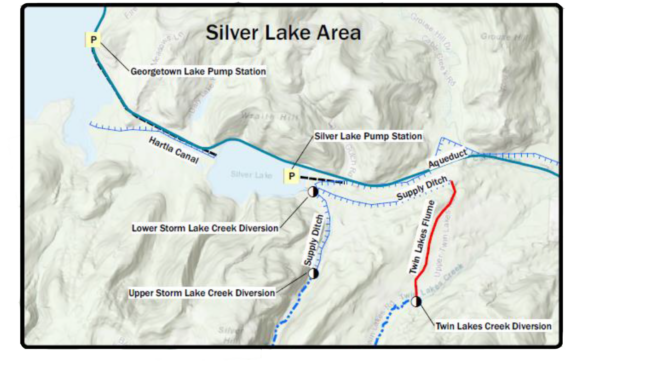 A data center proposal in Butte from Sabey Data Centers would rely on the Silver Lake Water System, which provides water to industries as well as maintaining in-stream fisheries flows. The system was designed in the late 1800s to support mining and smelting, during a relatively cooler period with more reliable snowpacks, spring runoffs, summer precipitation, and fewer demands upon the resources. Recent conditions underscore current climate realities. Todd Blythe of the Montana Department of Natural Resources and Conservation recently noted in the Anaconda Leader that Georgetown Lake — which sits just below Silver Lake — had below-average surface elevations in July and August based on 80 years of data, with inflows at roughly 14% and 39% of normal. And the Clark Fork Coalition measured single digit cubic feet per second flows in the Upper Clark Fork in 2016, 2021, 2024, and 2025.
Questions also remain about the true scale of the Sabey project and whether Sabey’s water consumption predictions correspond to the initial phase of development or the entire project. Sabey is purchasing four lots on 600 acres. The properties are not contiguous, raising the question of whether Sabey intends to build its currently proposed project on all four parcels or whether it intends to build more data centers than it has stated.
Another data center developer, Quantica, wants to build a massive data center near Broadview, an area that lacks sufficient drinking water. Central Montana’s lack of water availability has long been a serious concern. The Lavina-Broadview branch of the 230-mile Mussellshell Judith Rural Water Project pipeline — an expansive new publicly-funded water system that has been in development for decades — is scheduled to reach Broadview this year. That project will deliver just under a half-million gallons of water each day to the Broadview community. The water is intended to be used as drinking water.
Quantica has purchased 5,000 acres of land south of Broadview and has leases on an additional 40,000 acres for energy development. The proposed 1,000 megawatt data center represents an electricity need far greater than NorthWestern Energy’s current average customer load for all of Montana. Quantica executives have not disclosed how they will provide water to their project, but residents and scientists agree that there simply isn’t enough high quality water near Broadview to meet the needs of the data center, whatever that need may be.
Data centers also pose a water contamination threat. Water discharges can be extremely hot and can contain high levels of dissolved solids and industrial chemicals. If the data center’s wastewater is discharged into a public wastewater treatment system, the existing system may not be designed to treat the pollutants in the data center’s wastewater. The scale of data center wastewater may also overwhelm local treatment systems. In rural Montana, where local wastewater treatment systems are often absent, untreated water may be directly discharged to waterways or land.
MEIC is engaging local communities and working with local and state governments to push for forward-looking regulations on data centers that see beyond the data center gold rush. Visit MEIC’s data center webpage and read the “Data Center Questions Needing Answers” and “Regulatory Solutions for Data Centers in MT” documents for more information.
This article was published in the March 2026 issue of Down To Earth.