by Anne Hedges
A former Montana Public Service Commissioner once told me that being term-limited was unfortunate because after nearly eight years on the PSC, he was finally starting to understand the issues. Unfortunately, he still knew far too little to notice when the utility was using bogus arguments in order to manipulate the PSC to increase its revenue for shareholders at the expense of residential customers.
Anecdotes like this make it hard to defend the status quo when it comes to the PSC. The last decade was riddled with scandal after scandal. Our Commission is a regional embarrassment in the energy world. All too often, Montana Commissioners are elected to office with no knowledge or experience in the energy sector and are expected to stand up for consumers against well-heeled utility lawyers with decades of experience. Far too many have been former legislators who seemed more interested in being in a high-paying public office than digging into the nitty gritty of energy law and policy. It doesn’t help that a public servant’s pension is calculated by averaging their last five years of state employment. PSC Commissioners are some of the best paid positions in state government.
The PSC is supposed to balance the needs of average Montanans with the need to have financially healthy utilities that can maintain low borrowing rates. Unfortunately, that balancing act has been skewed. The PSC’s regulation of NorthWestern Energy, for example, has resulted in a nearly 40% electric rate increase for residential customers since 2022. It resulted in Montanans electric bills increasing faster than inflation, faster than other states in the region, and faster than Montanans can afford.
Nearly everyone agrees that something needs to change. But what?
Montana is one of only 10 states that elects PSC commissioners. Many legislators and other interest groups are looking to establish an appointment process for commissioners. Last session, a bill supported by the Montana Chamber of Commerce that would have established an appointment process failed to pass the legislature. Since then, a bipartisan group of legislators and others have worked on a new proposal for the 2027 Legislature.
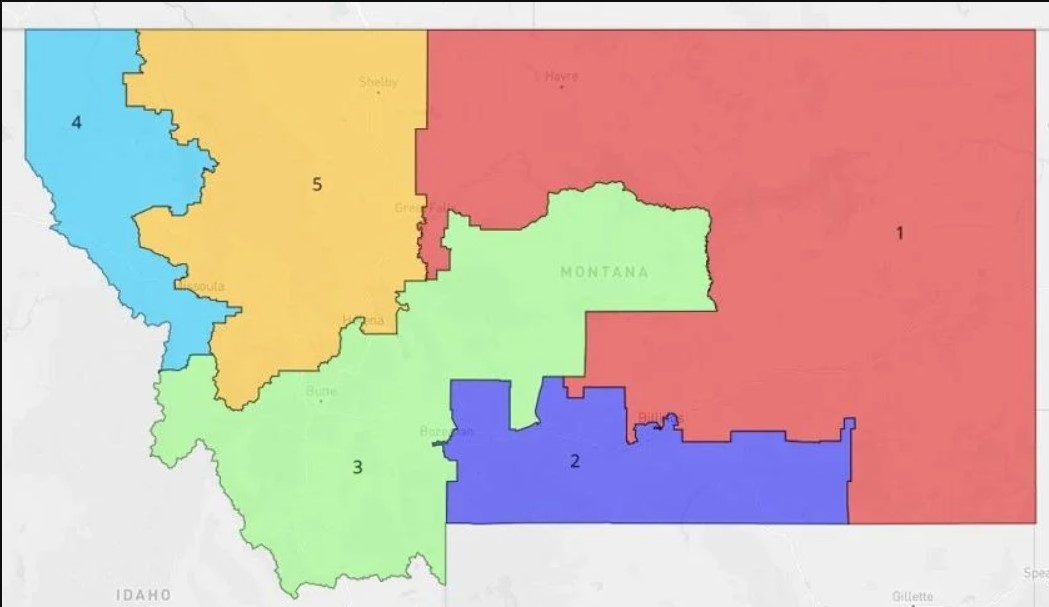
The 2023 Legislature established new PSC districts, splitting most of Montana’s largest cities in two.
The question is — who does the appointing? In a current proposal, the Governor decides on appointees based upon legislator recommendations and Senate confirmation. That idea should give everyone pause. The disastrous Board of Environmental Review is appointed by the Governor with Senate approval. It has been packed with industry lobbyists, retirees and consultants who take years to make decisions while projects move forward. Simply put, it is not a model that should be replicated, especially in a process that governs utility rates for hundreds of thousands of Montanans.
Gov. Greg Gianforte’s appointed Commissioners would most certainly have a strong bias toward monopoly utilities. Some argue that Democrats should be allowed to propose a certain number of appointees, but those recommendations would have to be approved by the Governor and the Montana Senate, and we’ve seen what the Senate has done with good judicial nominees.
The Legislature sets PSC districts, rather than the redistricting commission, which sets districts for every other state elected office. Unfortunately, the legislature has gerrymandered the districts to such an extent that it guarantees that unqualified candidates can win races as long as they win their primary.
A few years ago, a court found that the PSC districts were not representative of Montanans and required redistricting. Unfortunately, the legislature stepped in and severely gerrymandered the districts beyond anything rational. That legislative redistricting was challenged by Montana Conservation Voters and others with the help of the Upper Seven Law Firm. The Montana Supreme Court is currently deciding that case.
If Montana had more reasonably representative districts, elections could result in more qualified Commissioners. Until the court decides on whether or not the current districts are legal, it is premature to move to appointed Commissioners that would nearly guarantee utilities and business interests would win appointments over true watchdogs who wouldn’t make it through the filter of the Governor and Montana Senate. MEIC is going to wait for the outcome of the court case before deciding if appointments are our last best hope.
This article was published in the June 2026 issue of Down To Earth.