by Katy Spence
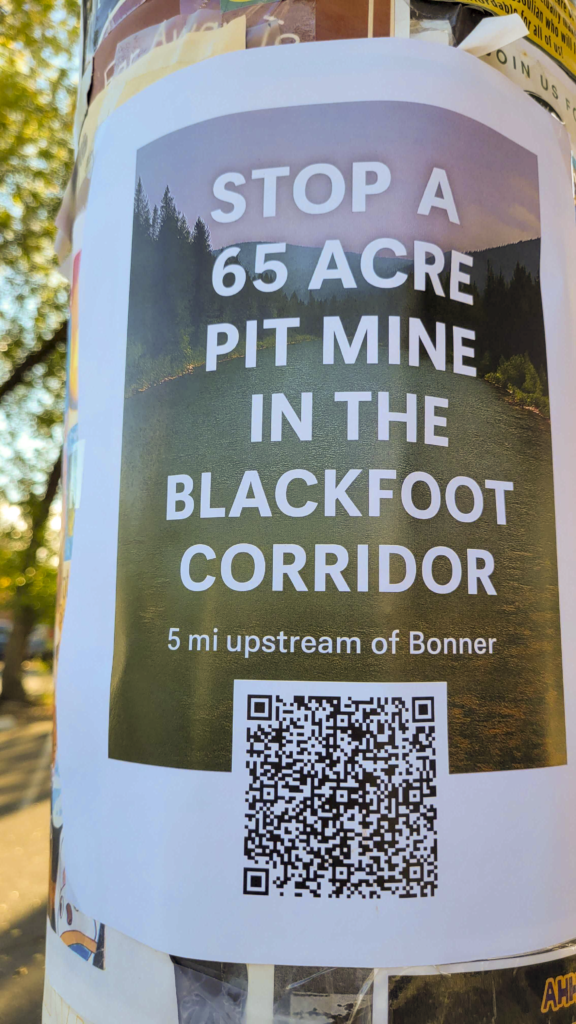
Last fall, Missoula residents (including myself) were alarmed to see posters around town highlighting a potential threat to the Blackfoot River: a proposed 64-acre opencut mine (gravel pit) with a crushing mill and asphalt plant on Highway 200, a few miles upriver of Bonner.
At MEIC, we discussed this news with dismay. In 2021, the Montana Legislature gutted protections against gravel pits in Montana. One bill eliminated the Montana Department of Environmental Quality’s (DEQ) authority to limit noise, hours of operation, and fire mitigation. It also significantly narrowed the agency’s consideration of water quality impacts and in many instances, the opportunity for public participation. It also allowed developers to classify their own operations as “dry” and limited DEQ to only 15 days to issue a permit, which is far too little time to allow for a public hearing, let alone to allow neighboring landowners to hire experts or have substantive input. Another bill severely knee-capped Citizen-Initiated Zoning — a process which previously let unzoned communities dictate what kinds of developments could join their neighborhoods — from preventing the complete use, development, or recovery of any mineral (such as gravel). Suffice it to say, options to resist gravel pits at the state level are limited.
But they’re not gone entirely.
As the Bonner and Missoula communities are exhibiting, local resistance is alive and well. A group of Missoula County residents has banded together to create Blackfoot River Community (www.blackfootrivercommunity.org) to share information, organize meetings, watchdog processes, and share out action alerts, including a petition (which has nearly 5,000 signatures as of this writing).
And they’ve seen some success due to incredible community outcry over the last three months. The project is undergoing scrutiny at local and county levels — though Missoula County has noted that it is extremely limited in how it can engage on this project and it is ultimately up to DEQ to permit — and more people are educating themselves on the process for permitting gravel pits and preparing to engage at the state level.
Even though there’s still a ways to go before being able to declare victory, it’s a good blueprint for any local community that is swimming upstream in an unfavorable regulatory landscape: get in touch with your neighbors, lobby your local government and legislators, get a petition going, write letters to the editor, hold a community meeting, call reporters, and try to get sideboards on the project (limits on lighting, hours of operation, dust, etc).
And importantly, keep this in mind when it comes to elections and our biennial state legislative session (mark your calendar for 2027!). MEIC lobbies for state-level protections and public participation in these processes, so it’s crucial to pay attention to bills that can have enormous impacts for our land and water resources.
This article was published in the March 2026 issue of Down To Earth.
Read full issues of Down to Earth here.