Montana Environmental Policy Act (MEPA)
Since 1971 The Montana Environmental Policy Act (MEPA) has been Montana's bedrock environmental law. In its simplest terms, MEPA institutes a “look before you leap” policy by requiring state agencies to consider the environmental, social, cultural and economic impacts of proposals like mines, power plants, subdivisions, and timber sales before the project is approved. The purpose of MEPA is to foster state government decisions that are informed, accountable, open to public participation, and balanced. MEPA has resulted in State agencies making better decisions based on community concerns for 36 years.
The MEPA process is often the only opportunity the public has to provide input on state agency decisions. Air quality and water quality laws are very limited in scope. MEPA is often the only time that State agencies consider the broad array of impacts a project could have on such things as cultural resources, fish and wildlife, or community safety. Such community issues often involve consideration of traffic and safety issues, like what time of day large trucks can drive by a school or whether it is necessary to provide fencing in between a playground and a rail yard, or whether a road should be paved to keep the dust down for area residents. MEPA gives a community the ability to provide input into decision making and help resolve issues before they become a problem. No other law allows consideration of such issues.
The Merits of MEPA
Where critics see delay, others see deliberation. Where they see postponed profits, others see public input. Where they see frivolous litigation, others see citizens requiring their government to live up to its responsibilities. And where they see a barrier to development, others see a shield that protects all Montanans from the shortsightedness of the state’s bureaucracy.
Efforts to Derail MEPA
For years polluting industries have said that MEPA is an overly burdensome law in need of streamlining. Whenever polluters have proposed legislative changes to MEPA, they have argued that the changes would have no substantive effect on public health and the environment. The legislature usually agrees, and makes the changes (all of which have weakened MEPA). These changes invariably do affect the State’s ability to protect public health and the environment.
The most damaging changes to MEPA came about as the result of a bill (HB 473) introduced by Rep. Cindy Younkin (R-Bozeman) in 2001. That bill prohibited an agency from using information discovered in the MEPA process to protect public health or the environment, unless another law authorizes it to do so. Another law passed in 2001, introduced by Sen. Duane Grimes (R-Clancy) changed MEPA to only allow the Montana Department of Environmental Quality (DEQ) six months to finish an environmental impact statement after it receives a complete permit application. Although DEQ has only 30 days to review an application and tell a company what information is missing, there are no deadlines for the company to respond.
An agency cannot begin the MEPA review until it has a complete permit application. At that time the agency must conduct an environmental assessment to determine if the project might have significant impacts. If a project might significantly impact public health or the environment, then the agency has to produce a more detailed EIS. But the agency only has 180 days to finish the EIS after it receives a complete application (although there is an opportunity to extend this by three months).
2007 Legislative Session
The 2007 legislature debated HB 610 (Rep. Jim Keane, D-Butte). This bill would have been the final blow to MEPA. It would have prohibited any lawsuits under MEPA, thus removing any consequences for agencies that fail to comply with MEPA. HB 610 would have wholly and fundamentally shifted the purpose of MEPA from a process that informs the public and decision makers about the impacts of state agency actions to one that only helps the legislature decide if environmental laws are working. HB 610 would have eliminated the incentive for agencies to provide the public with adequate information about the impacts a project will have on cultural resources, public health, the economy and the environment. Many projects have been improved as a result of public involvement and thorough analysis under MEPA. The bill was ultimately tabled in the Senate Judiciary Committee.
2009 Legislative Session
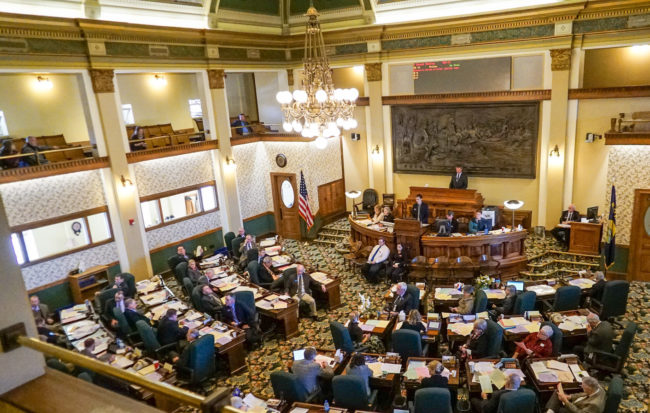
With one exception, all the attempts to weaken or eliminate the Montana Environmental Policy Act failed this session.
- HB 566: (Rep. Llew Jones, R-Conrad). This bill was the first anti-MEPA bill to fail. It would have prevented a court from stopping a project from proceeding even if the State had failed to comply with MEPA. This would have, in effect, made compliance with MEPA optional, as there would have been no consequences for ignoring the law. Thanks to House Democrats it failed to pass 2nd reading in the House by a vote of 50-50. [READ FACT SHEET ON HB 566]
- SB 417: (Sen. Jim Keane, D-Butte). This bill would have prohibited all lawsuits under MEPA, regardless of whether the State had complied with the law or not. It too would have eliminated any consequence for an agency ignoring MEPA. It died on a party-line 7-7 vote in the House Federal Relations, Energy, and Telecommunications Committee (FRET).
- SB 440: (Sen. Kelly Gebhardt, R-Roundup). This bill would have exempted all air pollution permits from MEPA. Thanks, in part, to the efforts of landowners near the proposed Highwood Generating Station, the Democrats in FRET killed this bill on a 7-7 vote. [READ FACT SHEET ON SB 440]
- SB 481: (Sen. Greg Barkus, R-Kalispell). This bill would have exempted all projects funded with federal stimulus dollars from MEPA. This bill also died on a party-line 7-7 vote in FRET.
- HB 529: (Rep. Llew Jones, R-Conrad). This was the only MEPA-weakening bill to pass. It exempts wind farms on State school trust land from most review under MEPA. The State only has to consider the impacts to State land from the turbines located on State property. So if a large wind farm is located adjacent to State land but with only a few of its turbines on State land, there will be no environmental review of the entire project, just of the State land portion. Considering the potential cumulative impacts from large-scale wind development, it is very unfortunate that the full impact will not be studied. The bill passed the House 71-29 and the Senate 33-17, and is now law.