by Ben Catton
Northwestern Montana’s Cabinet Mountains host rare inland temperate rainforest, providing vital habitat for threatened grizzly bears, wolverines, and bull trout. The area holds deep cultural importance for the Confederated Salish and Kootenai Tribes and has been federally protected since its 1935 Primitive Area designation and later inclusion in the 1964 Wilderness Act. Yet despite nearly a century of protections for this remarkable landscape, the Cabinet Mountains remain under threat from mining interests seeking to extract silver and copper from beneath the Wilderness.
Last year, Hecla Mining Company’s Libby Exploration Project received FAST-41 designation from the Trump Administration, granting it preferential federal permitting status. That designation helped shortcut meaningful environmental analysis and public scrutiny. The project received official approval in the midst of the 43-day-long government shutdown. The approval reflects a broader effort by the Trump Administration to weaken environmental review and accelerate extractive development on public lands.
In late March, alongside a coalition of local and national organizations, MEIC brought suit against the Trump Administration’s Forest Service and Fish and Wildlife Service for their defective environmental assessment and failure to conduct a full environmental impact statement before approving this project.
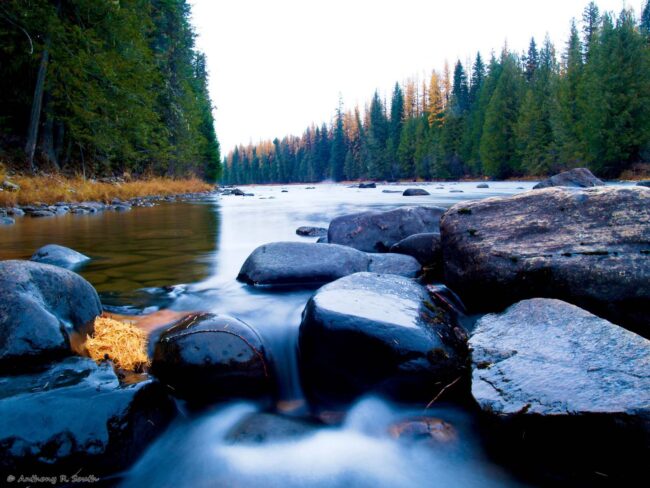
Yaak River in the Fall. Photo by Anthony South/Yaak Valley Forest Council
The agencies ignored serious risks to water quality, threatened species, and the integrity of the wilderness itself. The project could dewater lakes and streams within the Cabinet Mountains Wilderness, increase pollution in Libby Creek — critical habitat for threatened bull trout — and fragment habitat essential to the already-vulnerable Cabinet-Yaak grizzly bear population. Not least of all, Hecla Mining Company possesses a troubling track record at its other ventures. To name but a few, Hecla violated its National Pollution Discharge Elimination System permit at the Lucky Friday Mine roughly 200 times, in one instance exceeding the daily zinc limit by 42,000%. At the same mine, unsafe working conditions and unfair labor practices led to a strike of more than 200 union workers. Environmental infractions at the Greens Creek Mine in Alaska led to elevated toxic metal levels in waters, impacting local coastal wildlife. When greenlighting the Libby operation, however, the Forest Service neglected to account for this documented pattern of regulatory infractions.
For decades, conservation groups including MEIC, Cabinet Resource Group, Save Our Cabinets, Earthworks, Clark Fork Coalition, and Yaak Valley Forest Council have repeatedly challenged ill-conceived and mitigation-deficient mining proposals in the Cabinets with the invaluable help of expert lawyers at Earthjustice. The law is clear: projects in this landscape must demonstrate they will not significantly harm wilderness values, clean water, or endangered species. MEIC remains commited to ensuring the law is strictly enforced to safeguard this irreplaceable and ecologically vital wilderness landscape.
This article was published in the June 2026 issue of Down To Earth.