
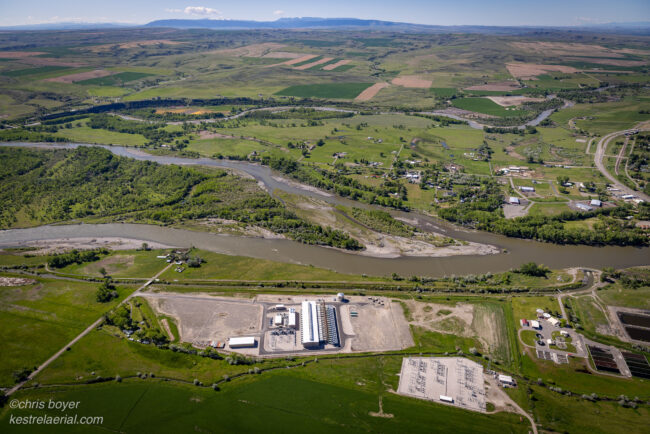
NorthWestern’s new gas plant on the Yellowstone River. Photo by Kestrel Aerial.
by Anne Hedges
Earlier this year, the Montana Supreme Court directed the Department of Environmental Quality (DEQ) to comply with Montana’s constitution and analyze the impacts of the greenhouse gas emissions from NorthWestern Energy’s Laurel Generating Station (sometimes referred to as the Yellowstone County Generating Station) As predicted, DEQ’s attempt was lackluster. On September 29, Earthjustice and Western Environmental Law Center, on behalf of MEIC and Northern Plains Resource Council, filed a challenge to DEQ’s continued failure to analyze, disclose, and consider the impacts of greenhouse gas emissions from one of the largest pollution sources ever to be permitted in Montana.
In early January, the Supreme Court relied on its recently issued Held v. State of Montana youth climate case when it ruled that DEQ was required to consider greenhouse gas emissions and their impacts in its permitting process for NorthWestern’s Laurel gas plant. In the Held case, the court found that a healthy climate was part of Montana’s environmental life support system and therefore subject to constitutional protection under Montanan’s right to a clean and healthful environment. The Montana Legislature immediately tried to undermine the ruling by carving out exemptions to the Montana Environmental Policy Act (MEPA), the law at the center of Held and the MEIC gas plant cases.
DEQ appears to be emboldened by the Legislature’s disdain for MEPA and chose to ignore the Supreme Court’s rulings, the Montana Constitution, and the purpose of MEPA in its revised analysis for the gas plant. DEQ’s MEPA analysis only contained one vague sentence on climate change impacts in Montana. If DEQ’s interpretation of MEPA is accurate, Montanan’s constitutional right to a stable climate was dealt a major blow. MEIC, Northern Plains, and our attorneys believe a stable climate is worth fighting for, even when DEQ doesn’t seem to think so.
While DEQ’s analysis was severely flawed in a number of ways, perhaps nothing was more egregious than its refusal to consider more than one year’s worth of the gas plant’s greenhouse gas emissions, even though the plant is expected to operate for more than 30 years. So instead of analyzing the harm that could result to the climate, water resources, wildlife, public health and the economy from 25 million tons of greenhouse gas, DEQ only considered the emissions from less than one million tons of pollution. DEQ was made aware of its error during the public comment period, but when it issued its response to comments, it said it would answer that issue in a different section of its response. However, the referenced provision failed to address the concern. DEQ simply failed to do its job.
We hope that a court can course-correct DEQ so that its guidance document (see article on pg. 11) and future MEPA analyses do not contain the same errors that allow the state to ignore the vast majority of greenhouse gas emissions and resulting harm from polluting industries.
This article was published in the December 2025 issue of Down To Earth.