by Nick Fitzmaurice
NorthWestern Energy often pays lip service to clean energy and environmental commitments, but looking at trends in the utility’s generation portfolio tells a radically different story. Every year, NorthWestern updates its website to show the previous year’s generation mix, flaunting a seemingly large carbon-free percentage, but previous years’ generation portfolios can’t be accessed for comparison. However, MEIC absolutely tracks these portfolios from year to year.
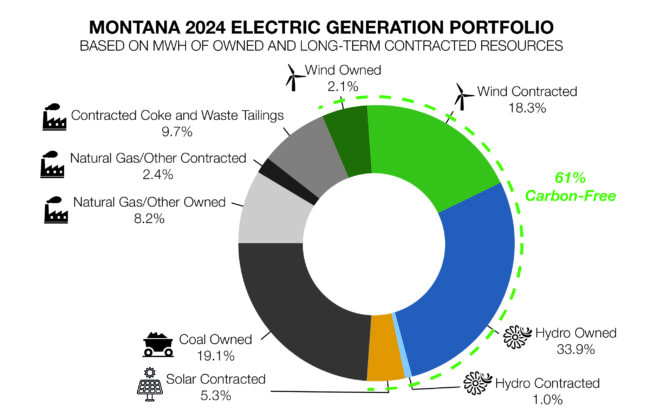
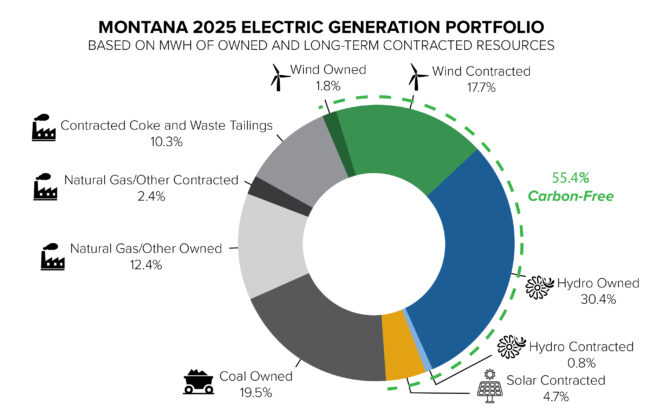
In 2024, NorthWestern showed a 61% carbon-free generation portfolio in Montana, based on total delivered megawatt hours (MWh) of energy. However, despite Montana’s geographic positioning with the second highest wind generation potential and fourth highest solar generation potential in the nation, only 2% of NorthWestern’s 2024 portfolio consisted of wind or solar energy owned by the utility. That 2% came from two wind facilities that were built over a decade ago, while 35% of the portfolio came from hydro resources that pre-date NorthWestern. The remaining carbon-free wind and solar came from energy contracts that NorthWestern is required to purchase. To be clear, NorthWestern can’t take credit for most of the existing carbon-free resources in its portfolio and is doing nothing to increase its low-risk carbon-free resources.
In fact, the carbon-free generation in NorthWestern’s portfolio is actually shrinking. In 2025, NorthWestern reported an only 55% carbon-free portfolio in Montana. This reduction is largely attributable to the Yellowstone County Generating Station gas plant coming online at the end of 2024, as well as diminishing output from hydro facilities due to prolonged drought conditions. Unfortunately, the outlook for carbon-free generation in NorthWestern’s portfolio is even worse.
NorthWestern acquired Avista’s 222 megawatt (MW) and Puget Sound Energy’s (PSE) 370 MW of the Colstrip plant on January 1, 2026, adding to its existing 222 MW share. A significant portion of the 222 MW from Avista is already being dispatched for NorthWestern’s Montana customers, which will reduce NorthWestern’s carbon-free percentage even further in 2026, while the utility has indicated the 370 MW from PSE could be used for Montana customers (i.e., new data centers) beginning in 2027. Meanwhile, NorthWestern is allowing its contract with the Judith Gap Wind Facility to expire at the end of 2026, meaning even less carbon-free energy in the coming years. Judith Gap has been NorthWestern’s most productive wind resource, supplying over 6% of the utility’s total delivered electricity in 2022 (the most recent year for which MEIC has comprehensive data).
MEIC can’t anticipate exactly how much energy each of NorthWestern’s resources will generate in the coming years. However, analyzing the utility’s entire portfolio of resources would suggest that the additional Colstrip plant shares and removal of Judith gap from the portfolio will likely bring NorthWestern’s carbon-free generation well below 40%, and potentially as low as 21% depending on how various resources are dispatched (or not) to meet customer needs. This is why MEIC is engaging so heavily in NorthWestern’s Integrated Resource Plan, which currently lays out a 20-year future almost completely devoid of new low-cost wind and solar projects (see article on pg. 18). Other utilities across the country and around the world are rapidly developing new wind and solar projects, and we need NorthWestern to do the same.
This article was published in the June 2026 issue of Down To Earth.