by Ben Catton
Last spring, the Montana Legislature passed HJ 61 (Rep. Josh Seckinger, D-Bozeman), authorizing an “interim study on the property insurance market in Montana.” Due to the explicit ties between land-use planning and climate change, MEIC has been tracking this legislation and the study’s development very closely.
The resolution notes that “property insurance rates have been increasing significantly for all Montanans, regardless of where they live. Montana had the fifth fastest increase in rates in the nation in 2024, and Montana’s cumulative increases in insurance rates from 2019-2024 are 44.3%.” Remarkably, the Montana Legislature ranked this study resolution as the most deserving of time and resources. It was assigned to the Economic Affairs Interim Committee (EAIC).
Under the previous Commissioner of Insurance, Troy Downing, Montana chose not to participate in a national “call for data” from insurers that provided a look at ZIP code level trends in homeowners insurance premiums from 2018-2022. For the 43 states that did participate, the data was revealing, finding that insurance claims widely correlate to climate change-related impacts, especially in wildfire-prone areas.
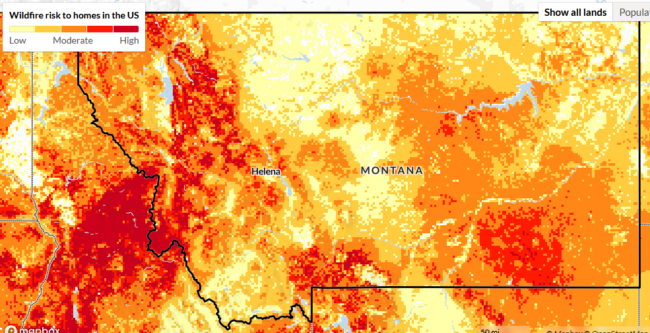
Map via Wildfire Risks to Communities
While these aren’t huge surprises, they are extremely valuable data points for understanding and seeing how trends within a small or specific region influence the larger statewide insurance market. Homeowners in low-risk areas may be subsidizing the insurance costs of homeowners in high-risk areas like the wildland-urban interface (WUI). Comprehensive data down to the zip code level could illustrate if insurance companies are increasing premiums on homeowners in low-risk areas so developers can continue to build and insure homes in the riskier WUI (see article in September 2025 issue of Down to Earth). Without the data, it’s hard to know.
In one HJ 61 meeting, the lack of data demonstrated its problematic effects when Sen. Mark Noland (R–Bigfork) asked if the substantial insurance losses from 2025’s California fires could impact Montana insurance rates. The Deputy Insurance Commissioner acknowledged that a lack of Montana-specific data can impact credibility, necessitating the use of data from other states to inform rate-setting decisions. Without local data, insurers assess future uncertainty by examining states with similar environments.
With continued encouragement from EAIC through HJ 61, the current Commissioner of Insurance, James Brown, has now committed Montana to participating in the next national call for data, though it remains to be seen if that data will be usable in time for the 2027 legislative session.
HJ 61 resolves that the results of the EAIC’s study “be reported to the 70th Legislature.” Because EAIC will be required to produce a report that includes “findings, conclusions, comments, or recommendations” of the HJ 61 study, it should make clear that climate change disasters and insurance nonrenewals are major threats to Montana households. The report should reflect that every expert that has come before the panel has made connections between climate models, risk analysis, and insurance repricing and nonrenewals. The report should recommend better data collection, including transparency behind insurance decisions and their connection to climate risk analysis. Finally, the report must outline proactive solutions that experts have identified to maintain insurance availability and affordability for Montana households, including but not limited to smarter land-use planning, incentivizing community-level hardening to fire risk, and improved building codes.
The best solutions require the best data. Policy solutions transcend ideology and become nonpartisan when they are backed by facts and data. This summer, call EAIC at 406-444-3064 and encourage a thorough report about climate impacts on insurance rates. Call the Commissioner of Insurance at 406-444-3525 and encourage transparency in Montana’s insurance markets.
This article was published in the June 2026 issue of Down To Earth.